
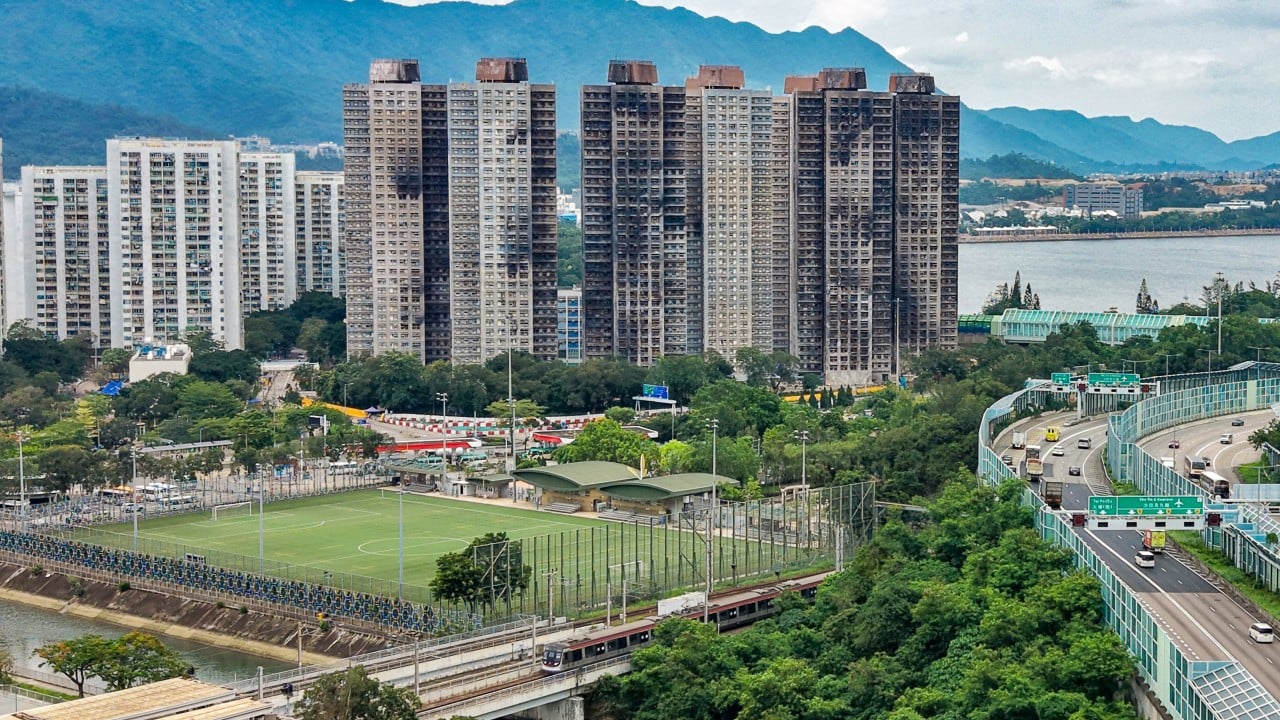
Hong Kong’s competition watchdog aims to submit proposals to criminalise bid-rigging as early as September, paving the way for the government to table legislative amendments by the end of the year, following the city’s deadliest fire in decades.
Senior Counsel Jat Sew-tong, who assumed the role of chairman of the Competition Commission last month, said on Friday that the watchdog would also launch a study into the city’s auto fuel market amid a surge in prices. The market has faced long-standing allegations of price-fixing.
In a report submitted to the independent committee investigating last November’s Tai Po fire, which killed 168 people and displaced 5,000 residents, the commission endorsed criminalising bid-rigging following alleged malpractice in the HK$336 million (US$43 million) renovation tender at the fire-ravaged Wang Fuk Court.
The commission said it was considering a “dual-track” legal framework, comprising both civil and criminal regimes, an approach adopted by other jurisdictions and supported by the Bar Association.
During his first media briefing as chairman, Jat said the commission had been working closely with the government and the Bar Association to review the Competition Ordinance and devise measures to combat bid-rigging, including criminalisation and higher civil penalties.
Without providing further details, he said the commission hoped to put forward its proposals in September or October, coinciding with the release of the judge-led committee’s investigation report, with the aim of having the government submit an amendment bill to the legislature this year.
However, the commission stressed that the final details and timeline remained subject to government approval.
“We are looking [at] all possibilities and see how we could make the ordinance effective and have a sufficient deterrent effect to this kind of behaviour,” Jat said.
“We hope we can achieve a situation where this kind of behaviour would no longer continue.”
A reform to the existing regime, under which serious anti-competitive acts such as bid-rigging are only punishable by fines, was brought up only after the tragedy. Jat declined to comment on the commission’s past performance in tackling bid-rigging, calling on the public to look ahead.
“It is never too late. Sadly, the event has occurred. Nobody wanted to see that, but what has happened, it has happened,” Jat said.
“We hope to see whether we could improve the legislative structure, the legislative regime, to ensure, as far as possible, that similar events will not happen again.”
Jat said a maximum penalty of seven years’ imprisonment for the criminal offence of bid-rigging, as previously proposed by the Bar Association, was a practical suggestion that and the commission would actively consider.
Although the commission currently lacked criminal prosecutorial powers, Jat noted that the division of labour after criminalising bid-rigging would require further study and discussion with the relevant departments and that all proposals were subject to the government’s final approval.
He also highlighted the need for additional manpower and resources to enforce the law after the criminalisation of bid-rigging.
In the short term, the commission has worked with the Home and Youth Affairs Bureau to require tenderers for large-scale renovation projects to sign a non-collusion clause as a stopgap measure and is considering requiring statutory declarations.
Police have also backed the push to criminalise bid-rigging, proposing introducing legislation enforced by a designated agency, along with more attractive leniency and cooperation agreements or even immunity from prosecution, for whistle-blowers.
On the surge in fuel prices, Jat said the commission would launch a new study into the city’s auto fuel market, in the form of a survey, following an earlier study completed in 2017.
“We hope to be clear about the actual situation [with] the auto fuel price and to propose suggestions to ensure there is no anti-competitive behaviour in the market,” Jat said, without revealing further details of the study.
Separately, Jat announced that the commission would open its general meetings to the public to enhance transparency, although some agenda items would be deliberated in closed-door sessions if necessary.
“Increased transparency is always a good idea, not just to let the public know what we have been doing, but also to have an avenue for the public to monitor what we have been doing,” Jat said.
“And where appropriate, give us suggestions and opinions as to how we could do our tasks better.”
Established in 2012, the Competition Commission is an independent statutory body responsible for investigating conduct that may contravene the Competition Ordinance and enforcing the law.