
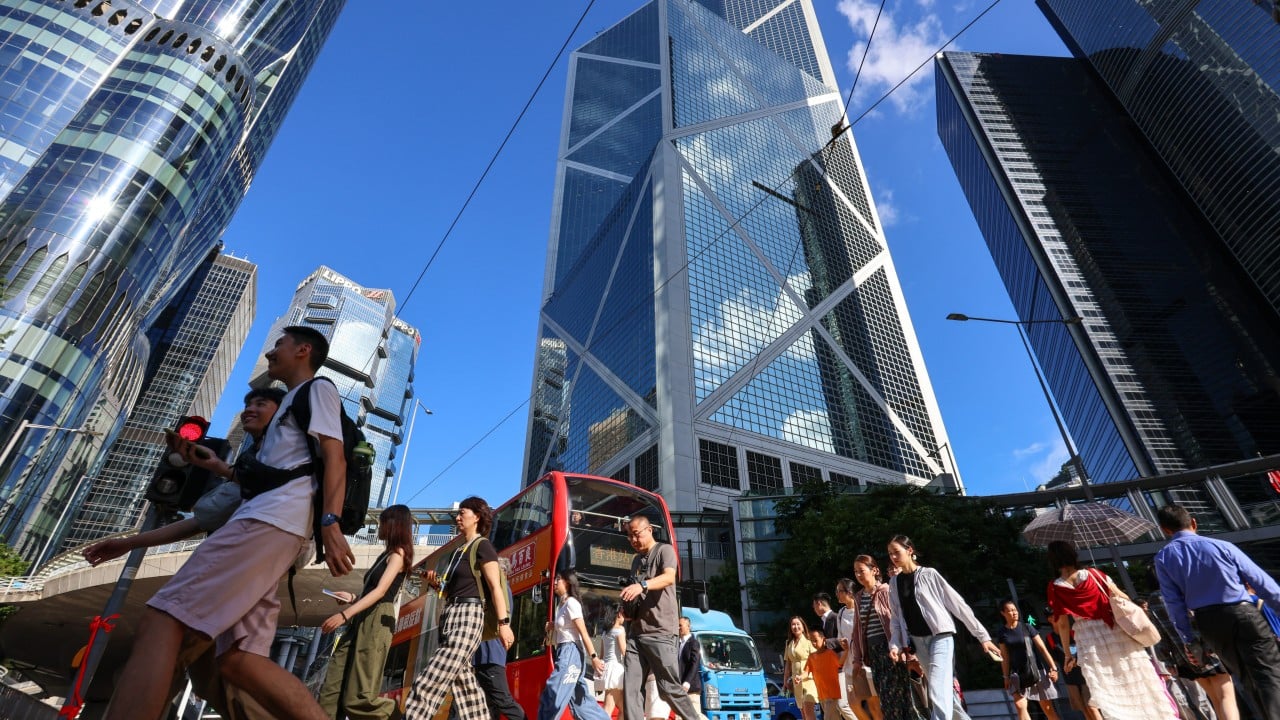
The US-Israeli war on Iran has unleashed sharp swings across global energy and financial markets, fuelling demand for safe-haven assets, with Hong Kong emerging as a potential beneficiary across gold, property and capital markets. In the third of a three-part series, we look at Hong Kong’s position as a stable base where demand for property has held firm despite the global turmoil.
The seven-week military conflict in the Middle East will redefine Hong Kong’s role as a global financial centre, positioning the city as a safe harbour for capital and investments.
Anecdotal evidence suggested that more banks had turned to Hong Kong to protect their businesses and committed themselves to expanding their presence in the city. At the same time, inquiries about adding allocations of mainland Chinese assets among global investors had recently increased, potentially enlarging the customer base for the city’s asset-management industry and family offices and driving demand for offshore yuan-linked financial products.
For years, Hong Kong’s status as a financial centre in the Asia-Pacific region has been challenged by Dubai, which has risen to prominence as a gateway linking Asia and Europe in capital flows, transport and logistics. With the war destabilising the Middle East – at one point forcing the closure of the Dubai International Airport and sending stocks in the Gulf region plunging – Hong Kong has re-emerged due to its geographical location, a pegged exchange rate, free capital flows and support from China’s economic strength.
“In that context, China and Hong Kong are attracting renewed attention,” said Gary Dugan, CEO of The Global CIO Office in Dubai, which advises family offices and ultra-high-net-worth individuals globally. “There is growing interest among some clients in increasing exposure to China and Hong Kong. It is less a simple flight to safety and more a reassessment of where investors see relative value, policy consistency and long-term strategic opportunity.”
Dubai now relies on trade, tourism and finance as the pillars of its economy, reflecting the success of its four-decade diversification away from oil for sustained growth. The United Arab Emirates city is home to Jebel Ali Free Zone, the biggest free-trade zone in the Middle East, and the second-largest stock market in the region, with combined market values of US$1.01 trillion. The city, also a global hub for gold trading, has a population of 4 million, about 80 per cent of which are foreign expatriates. Dubai’s economy grew by 4.7 per cent in the January-to-September period last year.
While Dubai is not a direct target of Iran’s strikes against US Arab allies, the closure of its international airport in the earlier days of the war alongside the stranding of overseas tourists was enough to raise concerns about geographic safety among investors and put new investment projects in abeyance.
Several Middle East-based banks had applied for business licences in Hong Kong to open offices, according to Alpha Lau Hai-suen, director general of InvestHK, an investment promotion agency under the city’s government, without revealing a specific figure.
Lau said in a previous interview with the South China Morning Post that she fielded an increasing number of inquiries from Middle East capitals about how to set up operations in Hong Kong after the Iran war broke out and Tehran threatened to bomb financial institutions in the Gulf region.
Global banks are also committed to boosting their footing in Hong Kong. JPMorgan Chase signed a 10-year lease with Sun Hung Kai Properties for 250,000 square feet of space in Artist Square Towers as its new Kowloon office.
Despite the uncertainty arising from the war, the US bank would stick to its plan to boost its corporate banking team across Asia by 10 per cent this year as part of a long-term strategy of increasing the headcount by 40 per cent through 2030, according to James Roddy, head of global corporate banking.
As a former British colony that was handed over to China in 1997, Hong Kong is now the world’s biggest market for the offshore yuan, with more than 1.1 trillion yuan (US$161 billion) of such deposits. The status has strengthened as Beijing boosts sales of dim sum bonds in the city and expands the cross-border exchange link programme allowing mainland traders access to Hong Kong-listed stocks. The city’s stock market is the third largest in Asia with combined market capitalisations of US$7.4 trillion.
The resilience of Chinese assets throughout the war has added to Hong Kong’s appeal, boosting demand for yuan-linked financial products. The yuan has appreciated 0.7 per cent against the US dollar, making it the only Asian currency to strengthen since the US started bombing Iran. Government bond yields have fallen while stocks have held up.
This is an encouraging sign for Hong Kong’s wealth- and asset-management industries, with HSBC’s Hong Kong unit saying some of its international clients had contacted local bankers for advice on diversifying their portfolios amid geopolitical tensions.
For Brook McConnell, president with money manager South Ocean Management, there is plenty of room for global investors to increase their exposure to Chinese stocks, which remain about 40 per cent below US equities in valuations.
“There’s been some thought that China may be a good place to ‘hide’ from high US stock valuations and China’s economy is not ‘dented’ as was feared from tariffs,” said McConnell. “Perhaps China comes in as a mediator to the US-Iran conflict, which raises its stature as a meaningful geopolitical power.”
Hong Kong is also capitalising on the geopolitical conflicts to complement its layers of financial services to global investors. The government was ramping up its drive to promote gold trading, a plan that would challenge Dubai’s global status in trading the precious metal, according to Brian Fung Wei-lung, CEO of the Hong Kong Gold Exchange.
To achieve the goal, the city will introduce tax incentives, expand gold storage capacity and upgrade its trading and clearing system, according to government plans.
With the war now showing signs of de-escalation, a ceasefire was not expected to erode Hong Kong’s appeal, which had been established through its geographic advantages and influence beyond financials, according to Ronald Chan, founder of Chartwell Capital.
“I do not expect recent interest in Hong Kong to reverse entirely, even if tensions ease,” he said. “There may be some natural fluctuations in capital flows, but Hong Kong’s appeal goes beyond that. Its growing strength in areas such as art, sports and culture can help reinforce a more well-rounded and sustainable global identity.”
Additional reporting by Yulu Ao