
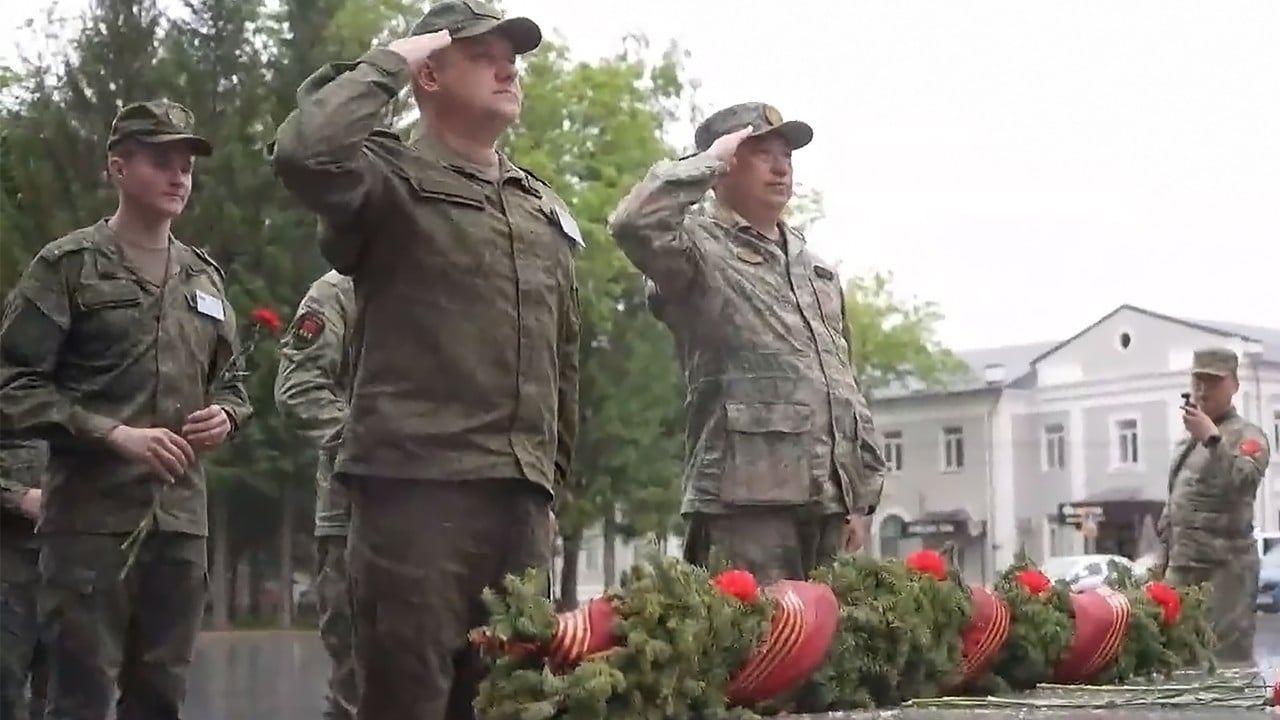
A PLA inspection team visited several facilities in Russia’s Eastern Military District this week, including an air defence missile unit in the far-eastern Jewish Autonomous Region, Russian media reported.
The visit, conducted under a decades-old confidence-building mechanism, came as President Vladimir Putin described China and Russia as “natural allies and partners”, while emphasising that their deepening military cooperation was not directed against any third party.
The June 2-3 inspection trip by the People’s Liberation Army was a routine verification exercise under a pair of agreements signed by China, Russia, Kazakhstan, Kyrgyzstan and Tajikistan, the Russian news agency Tass reported, citing the district command’s press office.
The 1996 Agreement on Confidence Building in the Military Field in Border Areas and the 1997 Agreement on Mutual Reduction of Military Forces in Border Areas formed part of the diplomatic architecture that later evolved into the Shanghai Five mechanism and ultimately the Shanghai Cooperation Organisation bloc led by China and Russia.
The Russian side framed the PLA trip as proof that the mechanisms created three decades ago remained effective and relevant.
“During the inspection, the Chinese delegation confirmed that the Russian Federation had fully met its international obligations and praised the effectiveness of the monitoring mechanisms established under the agreements with China,” Tass reported on Thursday.
Senior Colonel Liu Jinsong, who headed the Chinese team, was quoted by Russian news website Izvestia as praising the transparency of control mechanisms, along with the degree of organisational and logistics support provided.
“Under the strategic leadership of the two camps … we will reach mutual understanding and further strengthen the friendship between the two countries,” Liu said.
“And especially within the framework of this agreement signed by the five countries, we will also continue to develop this area and further strengthen our mutually beneficial cooperation.”
The Chinese delegation also laid a wreath at the Eternal Flame Memorial Complex in the Eastern Military District, according to Russian press reports.
But media reports did not provide further details about the visit, including the specific air-defence unit involved.
The 1996 and 1997 agreements followed decades of Sino-Soviet border tensions, including armed clashes in 1969 along the Ussuri River in northeast China’s Heilongjiang province. The nuclear-powered neighbours regarded each other with deep suspicion at the time – a dynamic that persisted into the early 1990s.
Their relations have since evolved into what both sides call a “comprehensive strategic partnership of coordination for a new era”. It has involved deeper political, economic and military cooperation, especially since Russia invaded Ukraine over four years ago.
Over the past decade, China and Russia have expanded their defence cooperation through regular joint exercises, strategic bomber patrols over the Pacific, naval drills across multiple theatres, and increasingly sophisticated military-to-military exchanges.
Relations with China had reached “an unprecedentedly high level”, Putin said in Beijing on May 20, marking his 25th official visit to China.
On Thursday, speaking on the sidelines of the St Petersburg International Economic Forum on Thursday, the Russian leader rejected suggestions that he had made “any U-turns” towards China since the Ukraine war.
“We are natural allies and partners. We are neighbours. Neighbours are not chosen,” Putin said, describing China as a rapidly growing global economic and political power.
He highlighted his personal bond with Chinese President Xi Jinping and said governments, ministries and major companies on both sides were actively implementing agreements reached during his recent visit to China.
Putin also stressed that military and military-technical cooperation between Russia and China was not linked to ongoing international crises or aimed at any third parties.
“We simply work and are friends with China not against anyone, but in each other’s interests,” he said.
According to Tass, presidential aide Yuri Ushakov announced this week that Putin would meet Chinese Vice-President Han Zheng on the sidelines of the St Petersburg forum to discuss “the prospects for the further development of relations with China”.