
International marques have failed to sustain the market share they regained in China early this year after consumers fell back in love with electric vehicles (EVs), a sector where domestic brands continue to enjoy an overwhelming advantage.
Foreign carmakers from Volkswagen to Toyota held a combined 30.3 per cent share of the Chinese automotive market in April, with about 418,140 vehicles handed to local customers, according to data from the China Passenger Car Association (CPCA).
In the first quarter, the carmakers – which retain an edge in building conventional petrol cars – commanded 39.8 per cent of the world’s largest vehicle market.
CPCA data showed that international brands accounted for 34.7 per cent of the Chinese market in 2025.
The rebound was driven largely by short-term weakness in domestic EV demand following subsidy roll-offs, rather than any reversal in structural competitiveness, Deutsche Bank said in a research report released this week.
“April data dashed hopes for a comeback by foreign brands,” said Steve Shi, a manager at Juchen Auto Trade, an auto service firm. “More Chinese motorists realised that EVs represented the future of mobility, although many of them still have faith in international brands in terms of product quality.”
Chinese EV assemblers, which dominated the domestic market, got off to a slow start this year as a national policy shift deterred thousands of consumers from buying pure electric or plug-in hybrid vehicles.
EV sales in China fell 25.7 per cent year on year to 1.06 million units in the first two months of 2026, CPCA data showed.
Beijing adjusted its EV subsidy policy this year, allowing buyers replacing an existing car to receive subsidies of up to 12 per cent of the new vehicle’s price, capped at 20,000 yuan (US$2,955), from January 1.
In the previous two years, consumers received a flat 20,000 yuan, regardless of price.
A buyer of an EV priced at 100,000 yuan now receives 12,000 yuan – 8,000 yuan or 40 per cent less than last year.
Tax incentives have also been scaled back. Buyers, who were exempt from the 10 per cent vehicle purchase tax last year are now subject to a 5 per cent levy as Beijing gradually withdraws support.
But newly implemented subsidies from local governments helped spur EV sales from March, while new models featuring better batteries and more advanced driver assistance systems lured more customers away from petrol-powered cars.
For example, in Chengdu, capital of southwestern China’s Sichuan province, first-time car buyers can receive subsidies of up to 8,000 yuan.
Chinese EV makers, ranging from BYD – the world’s largest EV builder – to Stellantis-backed Leapmotor revved up new model launches during the recent Auto China show in Beijing.
Dealers said foreign brands were set to lose further market share to Chinese rivals amid an accelerated pace of electrification on the mainland’s roads.
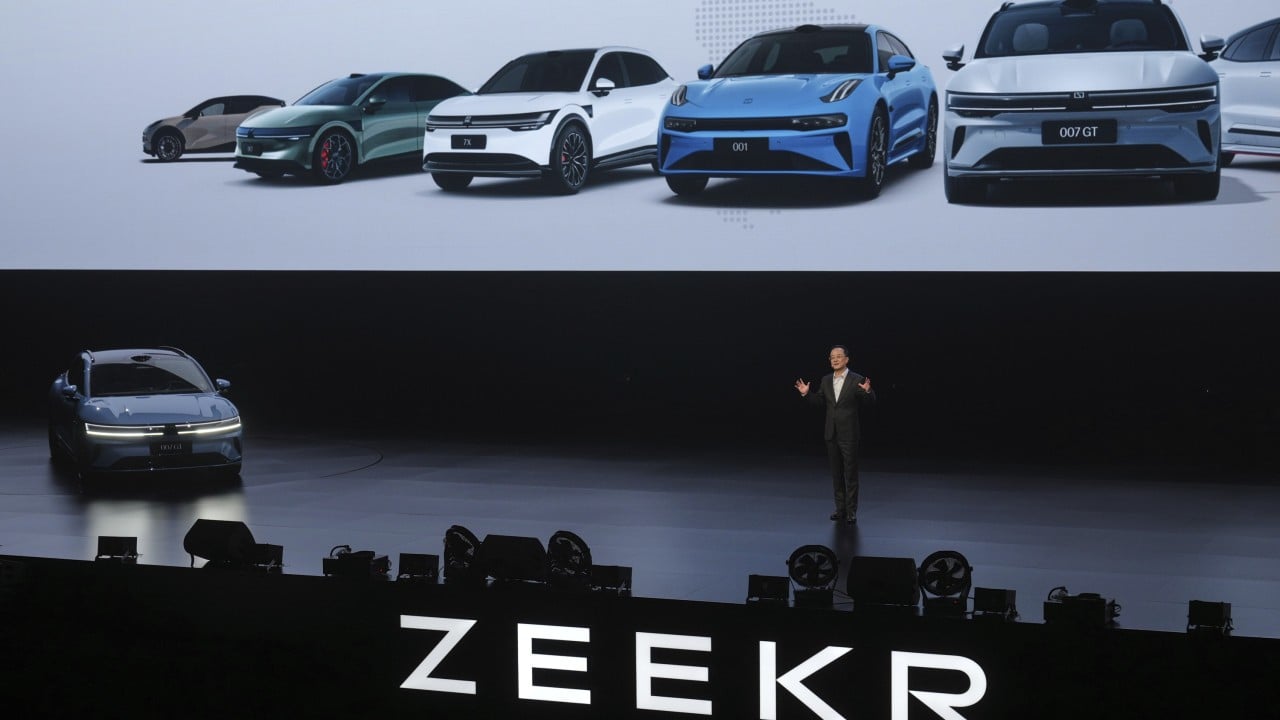
Chinese EV sales recovered firmly in May as Zeekr – a premium EV brand owned by Geely Auto, the country’s second-largest carmaker – and Leapmotor broke their monthly delivery records.
Foreign marques have been largely eclipsed by their Chinese EV rivals since 2020, when they held a combined 64 per cent of the market.
“China’s EV ecosystem nevertheless remains highly dynamic, supported by rapid innovation cycles, sharply lower battery costs and compressed development timelines,” Deutsche Bank said in the report.
“Industry consolidation is set to continue, with only about 15 out of 129 Chinese EV brands currently likely to survive by 2030, leaving a smaller group of well-capitalised, vertically integrated champions positioned to compete both domestically and globally.”