
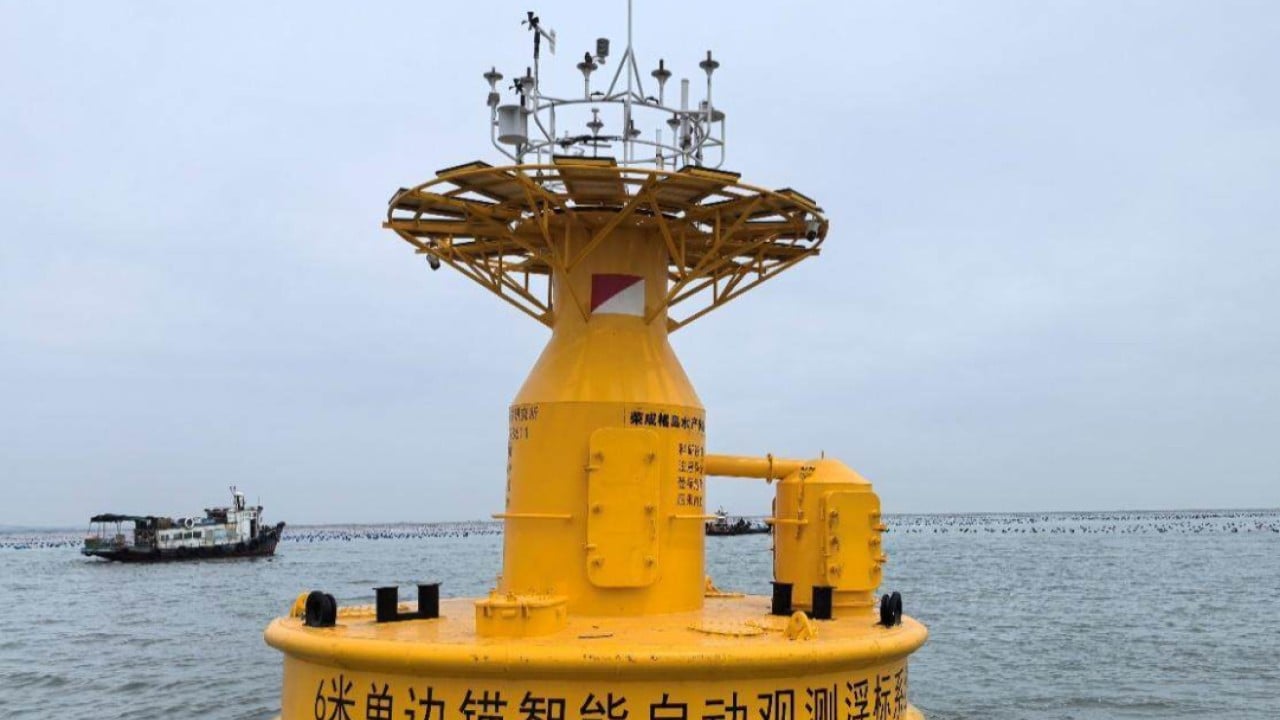
A giant orange disc settled into the waters off Rongcheng in eastern China’s Shandong province, marking the deployment of what Chinese researchers describe as the world’s first-of-a-kind intelligent ocean-observation buoy.
It abandons a mooring architecture that has dominated Western marine engineering since World War II.
The six-metre-wide (19.7 feet) platform has completed sea trials and officially joined the Yellow Sea observation network, enabling continuous, real-time monitoring across the entire water column, according to the Institute of Oceanology, Chinese Academy of Sciences.
“The world’s first buoy system designed with a disc-shaped single-side anchor structure has broken through the traditional single-point mooring structure at the centre of disc-shaped buoys,” the institute wrote in a statement issued last month.
The deployment also carried symbolic significance. As the new six-metre intelligent buoy entered operation, technicians simultaneously recovered a much smaller three-metre buoy that had served at the same station for more than 16 years.
The project represents a rare attempt to redesign a buoy configuration that has remained largely unchanged for nearly 80 years.
Traditional disc-shaped marine buoys – widely used in Western oceanographic systems since World War II – typically rely on a central single-point mooring structure.
The arrangement functions much like a balloon tethered to the seabed: relatively stable under moderate conditions, but increasingly vulnerable when strong currents, waves and subsurface profiling cables interact around the anchor chain.
For decades, ocean engineers have struggled with what researchers sometimes describe as a “tangling nightmare” – underwater observation cables wrapping around mooring lines during long-term deployments, threatening both data quality and system reliability.
The new Chinese platform seeks to address that problem by relocating the anchor system entirely to one side of the buoy.
According to the institute, the platform is the world’s first integrated observation system to adopt a disc-shaped single-side mooring structure.
Rather than suspending observation cables directly beneath a central anchor point, the design physically separates the profiling system from the anchor chain through an offset geometry combined with a rebalanced buoyancy layout.
Yet the buoy’s most significant innovation may lie not in its mechanical structure, but in its push to transform passive ocean monitoring into an artificial intelligence-assisted autonomous system.
The platform is equipped with high-precision sensors capable of monitoring wind, waves and ocean currents in real time while also identifying the shape and condition of underwater mooring structures.
The buoy also enables continuous full-depth profiling with real-time data transmission to shore-based laboratories using technology developed in China.
“For the first time, continuous, stable and real-time profile observation of marine water bodies with a single-anchor buoy system has been achieved,” the institute said. “This buoy is based on domestically developed and controllable technology.”