
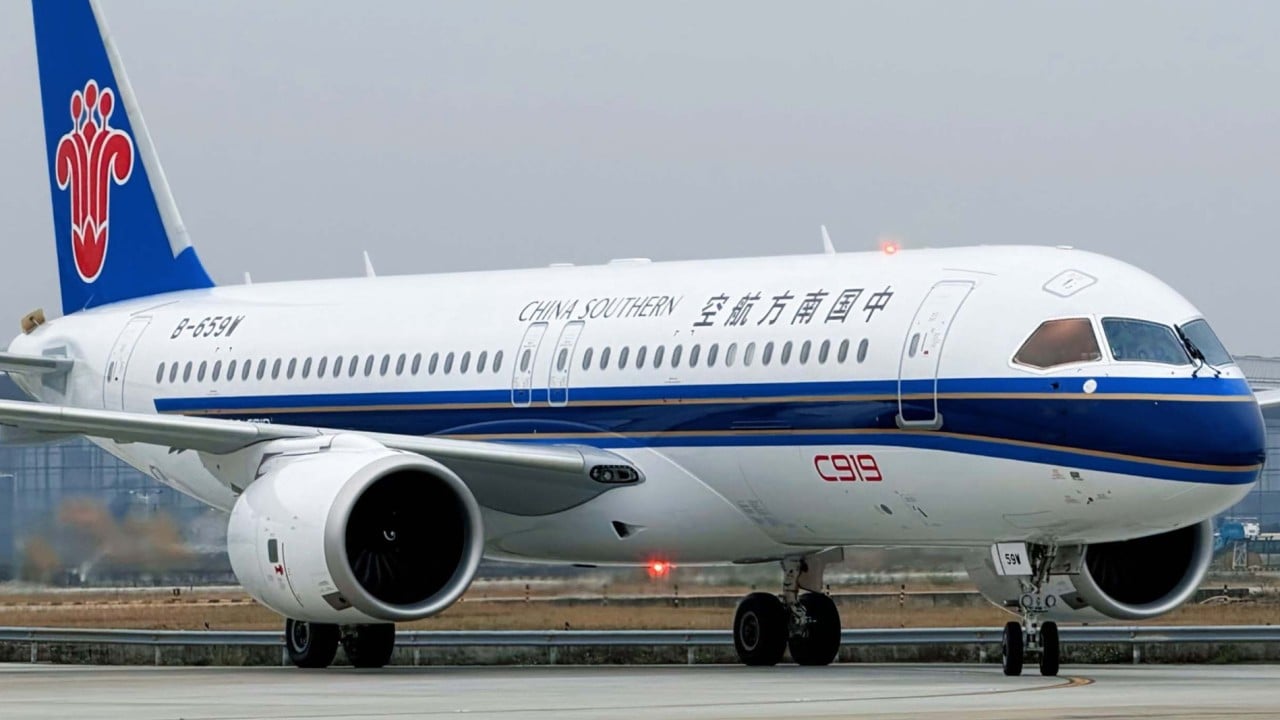
Deliveries of China’s home-grown C919 narrowbody airliner, billed to challenge mainstream models from Boeing and Airbus, appear to be delayed, with only three units shipped to Chinese carriers in the first quarter of 2026.
Observers point to several factors holding back the Commercial Aircraft Corporation of China (Comac). While some C919s are said to be stuck on the tarmac waiting for engines, analysts also say prioritising quality over speed is the right bet for the planemaker.
Only three C919 deliveries have taken place this year to date – two were issued to China Southern on February 5 and March 2 and one went to Air China on March 27 – with no shipment in January, checks of airline records by the South China Morning Post and data from UK-based aviation consultancy IBA showed.
A total of 35 C919s have been delivered since December 2022, when China Eastern received the first unit. The apparent stall suggests Comac may be falling behind its own schedule.
“It could again be C919s sitting with their wings bare – the CFM Leading Edge Aviation Propulsion (LEAP) engines are not arriving,” said Jason Zheng, an analyst with the Shanghai-based consultancy Airwefly.
“While planes wait for engines, engines wait for key parts like blades.”
CFM is a US-France joint venture established by GE Aerospace and Safran.
“Comac is racing against Boeing, Airbus and even airlines in the unrelenting scramble for access to scarce engines and it may be losing out in allocation,” Zheng said, pointing to a persistent mismatch between record-high demand and a fragile supply chain.
“CFM is producing engines at top speeds but a lion’s share flows to established buyers,” he added.
In a sign of how widespread the issue is, Airbus has complained about the “tight, late” supply of LEAP engines, while starting to pursue damages in a rising legal row with Pratt & Whitney over delayed engine shipments. The European producer also throttled jet delivery speed last year.
Zheng said the development and deployment of the indigenous CJ-1000 engine, from the Aero Engine Corporation of China, may be revved up since reliance on CFM as a sole source is seen as a vulnerability. In May 2025, Washington temporarily suspended the export of LEAP engines to Comac, a ban that was later lifted.
Suggesting initial teething problems, a source with knowledge of production also said a new assembly facility for the C919 in Shanghai operated below its design capacity at the start of the year, but expressed hope that the planemaker could make up for lost time.
The source, who asked not to be named because he was not authorised to speak to the media, also said Comac and airlines would have to go through a lengthy process of quality inspection and pilot and crew training, citing “onerous, stringent” requirements by Chinese aviation authorities.
He revealed Air China had at least one more new C919 that had wrapped up test flights and airworthiness assessments, but was still pending delivery as of the end of March.
“Sometimes a new plane would have to wait before an airline gets ready. There was also the hiatus of the nine-day Chinese New Year break in February.”
Richard Aboulafia, managing director of US-based AeroDynamic Advisory, said Comac may need time to stabilise production and supply chains.
“Looks like a serious underestimation of challenges associated with final assembly and supply chain management … [There may also be issues] building to a constant standard,” he noted.
Comac hit a monthly high in shipments at the end of 2025, with eight of the 15 C919 deliveries last year made between November and December. The sudden drop since January may indicate unexpected supply chain shocks, the source said.
The planemaker held an annual supplier conference on March 26 that pooled over 600 representatives from home and abroad for discussions on deals and building trust, according to a corporate press release. Attendees were also briefed on production and delivery plans for this year.
Zheng, meanwhile, said Comac was prudent and would not rush toward any target.
“It is significant that Comac is not compromising quality for the sake of meeting any target or expectations. Slow and steady is good here,” he added.
“The second quarter will be an opportunity for Comac to prove it can revert production and delivery back to normal. If first half delivery is less than 10 then stakeholders and observers will start asking more serious questions. For now, they think Comac just needs a bit more time.”