
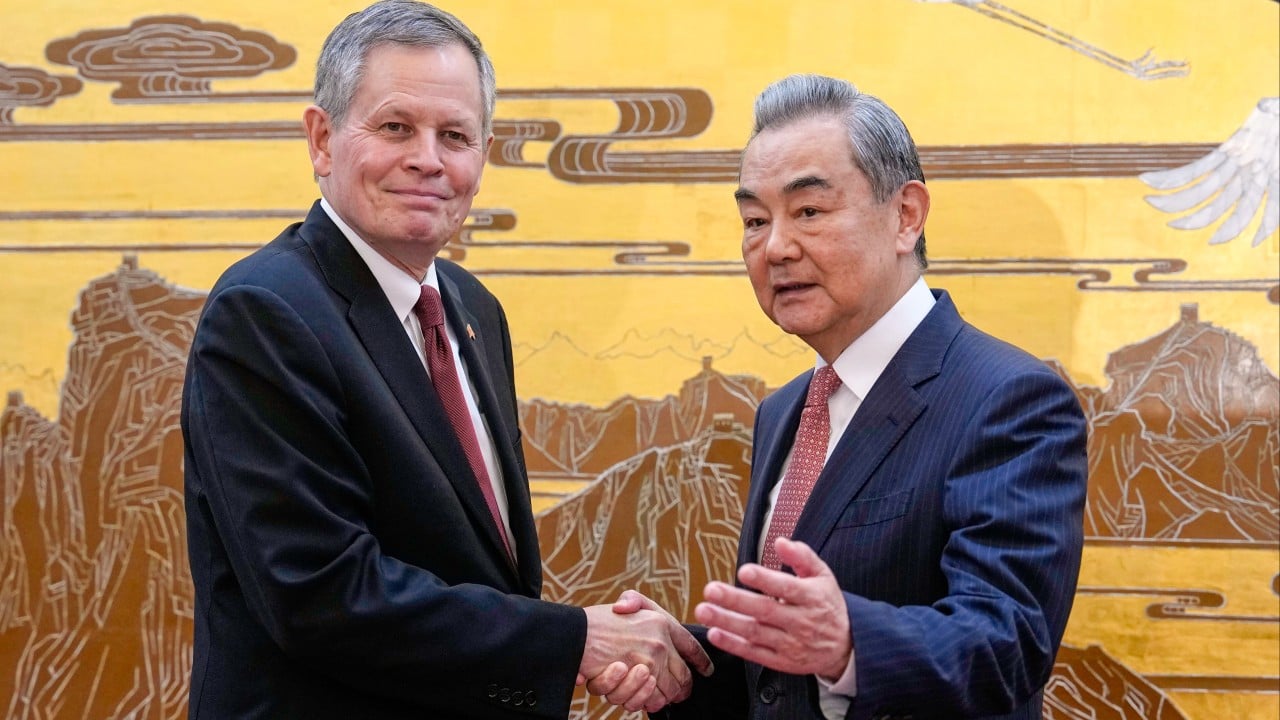
Chinese Foreign Minister Wang Yi told visiting US Senator Steve Daines that Beijing hoped to “truly stabilise and improve” Sino-American ties, a week before a highly anticipated summit between Xi Jinping and Donald Trump.
In his meeting with Daines on Thursday, China’s top diplomat said Beijing and Washington should seek “harmony without uniformity” and be “partners rather than adversaries”.
“The US should view China objectively, develop a rational perception of China, genuinely respect China’s core interests and properly manage differences,” Wang told Daines.
“Beijing would work with Washington to implement the consensus reached by the two leaders and truly stabilise and improve Sino-US relations,” Wang said, adding that they should jointly explore the right way for two major powers to get along.
Daines, a Republican from Montana and close Trump ally, is leading a five-member delegation visiting Shanghai and Beijing just days before the American leader’s rescheduled trip to Beijing.
If held on May 14 and 15 as planned, the summit would mark the first time a US president has travelled to China in more than eight years and Trump’s first foreign trip since the US-Israel war on Iran began on February 28.
Beijing has yet to officially confirm the visit.
In Thursday’s meeting with Wang, Daines thanked Beijing for its efforts to reopen the Strait of Hormuz and called for increased Chinese purchases of Boeing aircraft when Xi and Trump meet next week.
The Strait of Hormuz, a critical chokepoint for global energy supply chains, has faced unprecedented disruption following conflicting claims of jurisdictional control by Iran and the US.
“You are working to de-escalate tensions, to bring peace to the Middle East, to open up the Strait of Hormuz,” Daines said.
“I want to thank you for your personal effort yesterday to that end, to help us bring together a peaceful outcome from the current conflict in Iran,” he added, referring to Wang’s meeting with Iranian Foreign Minister Abbas Araghchi on Wednesday.
Wang said that despite “setbacks and turbulence” in the Sino-US relationship over the past year, the two countries had maintained stability overall thanks to heads-of-state diplomacy.
Announcing his trip on Monday, Daines, a member of the Senate Foreign Relations Committee, said it was essential to understand China’s innovation ecosystem to “effectively compete” with it.
He met Shanghai Mayor Gong Zheng on Tuesday, with Gong saying Shanghai would strengthen economic, trade and industrial investment cooperation with the US.
The mayor added that Shanghai hoped to deepen exchanges in culture, education and sports while strengthening interactions and cooperation among young people.
Daines’ trip is his second to China since Trump’s return to office in 2025, having visited Beijing in March last year to meet Premier Li Qiang and Vice-Premier He Lifeng amid America’s imposition of new worldwide tariffs.
The trip is also Daines’ seventh to China as a US senator and likely his last, following his recent announcement that he would not seek re-election.
The Republican senator is seen as a trusted backchannel figure between Washington and Beijing, leveraging his corporate background, including six years at Procter & Gamble in China in the 1990s.
Daines has played a vital role in US-China trade relations throughout both Trump administrations, reportedly helping lift China’s 13-year ban on US beef in 2017 and securing a US$200 million deal that year between Chinese e-commerce giant JD.com and the Montana Stockgrowers Association to source beef from the state.
Daines also acted as an informal intermediary to gauge Beijing’s position and communicate Trump administration objectives as US-China trade tensions escalated in 2019. He served as a regular consultant during “phase one” trade negotiations in 2019–2020 and held high-level meetings with Chinese officials.
The delegation of US senators includes Maria Cantwell, chair of the Senate Commerce Committee; Deb Fischer, a Republican focused on agriculture and transportation; Mike Lee, who focuses on constitutional law and economic policy; and Jerry Moran, chair of the Senate Commerce Subcommittee on Aviation, Space and Innovation.