
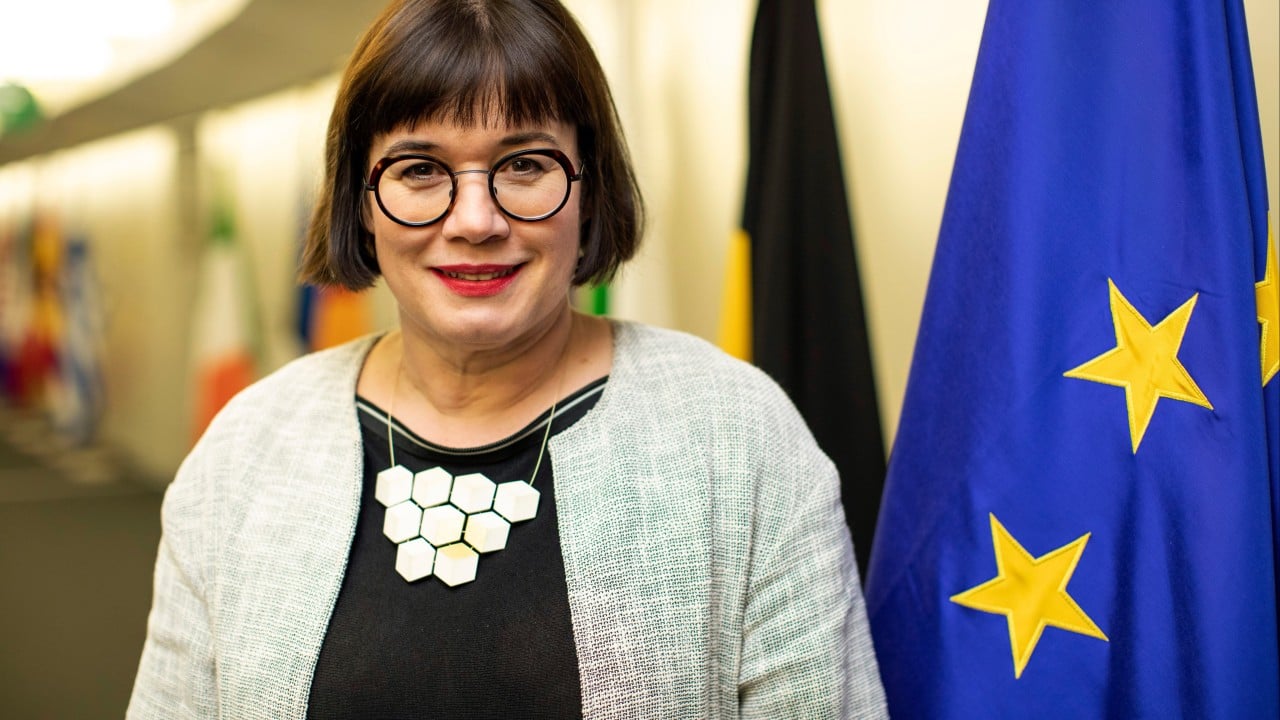
The EU’s outgoing top trade official Sabine Weyand used her departing appearance at the European Parliament to pour cold water on the prospect of an investment deal with China, hinting instead that new weapons for dealing with Chinese “macroeconomic imbalances” could be on the way.
Weyand, who is leaving her role as the EU’s director general for trade after a seven-year tenure, said the Comprehensive Agreement on Investment – a pact signed in the last days of 2020 but frozen soon after in a row over human rights – “was an agreement from another time and for another China”.
The German official, who leaves her post at the end of the month, quoted the EU’s former competition chief Margrethe Vestager, saying, “If something has been in the deep freezer for a long time, you shouldn’t take it out and serve it again.”
The remarks come as Beijing floats the prospect of reviving the deal in engagements with EU leaders. It has also proposed embarking on talks around a free-trade agreement, a suggestion that was embraced by German Chancellor Friedrich Merz last month.
Others, including Finnish Foreign Minister Elina Valtonen, have said China’s close ties with Russia would be a “disqualifying factor” on a potential deal.
Weyand instead made a rare public confirmation that the commission is considering new trade tools to deal with the imbalances stemming from “the impact China’s economic model has on the rest of the world”.
“I’m not talking about a cyclical imbalance in trade, I’m talking about structural macroeconomic imbalances or what the IMF calls macro-industrial policy, which really suppresses domestic demand and creates durable imbalances in the relationship,” Weyand told the parliament’s trade committee.
The veteran negotiator cited predictions that the country’s share of global industrial production was predicted to rise from 30 per cent today to up to 45 per cent in 2030, even as its share of consumption hovers at around 13 per cent.
“That is an imbalance that the world just can’t digest,” Weyand said, adding that Brussels needed to use its existing trade weapons “in a manner that’s coherent and consistent”.
“But we also need to reflect on whether we have the instruments we need or whether we need to develop our toolbox,” she said, adding that this was a question for her successor, but that “the commission will have an orientation debate about this at the end of the month”.
The South China Morning Post reported on Tuesday that EU officials were set to pitch what has been variously referred to as an “overcapacity” or “diversification” instrument to the commission’s leadership during the orientation debate on May 29.
It comes as the bloc struggles to deal with China’s rampant industrial development, which has seen its companies rise quickly up the value chain in a manner that has redrawn trade relations with Europe.
Business groups note that Chinese companies that were once suppliers and buyers are now out-competing them on price and often quality in China, Europe and third markets.
While acknowledging the country’s manufacturing prowess, there is frustration at the lack of transparency around state subsidies in China and the lack of effort to curb industrial overcapacity. The EU believes a combination of those factors is leading to a flood of Chinese goods coming to Europe at a significant discount, distorting the single market.
Weyand warned that while protectionist tools must be used, there must also be “breathing space” for European firms to catch up with the competitors from which they were being shielded.
“If we don’t use that breathing space to address the root causes of the lack of competitiveness, the industry won’t survive. We would risk turning the EU into an industrial museum where we only protect sectors that aren’t able to compete globally – that’s not what we want,” said Weyand, who will leave politics for a teaching role at the European University Institute near Florence.
The level of assertiveness towards China is expected to be debated by the bloc’s 27 national leaders at a European Council next month.
One country coming out strongly in favour of a more robust stance is Belgium. After returning from a visit to China this week, Belgian Foreign Minister Maxime Prévot said the EU must upgrade its approach.
He told Politico the bloc must be prepared for Chinese retaliation, but not deterred by the prospect.
“It is likely that any initiatives we might take would be met with retaliatory measures,” Prévot said.
“And that begs the real question: is Europe prepared to endure some temporary hardship for a few years in order to stand firm behind a series of measures designed to eventually re-establish a partnership based on a level playing field?”
Weyand also used the session to address the EU’s relationship with the United States. While she had been critical of the bloc’s tariff deal with the country, reached last year, she used her closing remarks to defend the pact.
“We’d all prefer to be in a situation where we can continue to rely on WTO rules governing all trade, including transatlantic trade – that was not on offer. I remain convinced the Turnberry Agreement was the best approach to defend European interests,” Weyand said.