
A proposal by the Quad to build a port in Fiji, seen by analysts as a move to counter China’s rising economic clout in the Pacific region, has fuelled doubts about whether the four-member security bloc is committed to completing the project amid differing policy priorities.
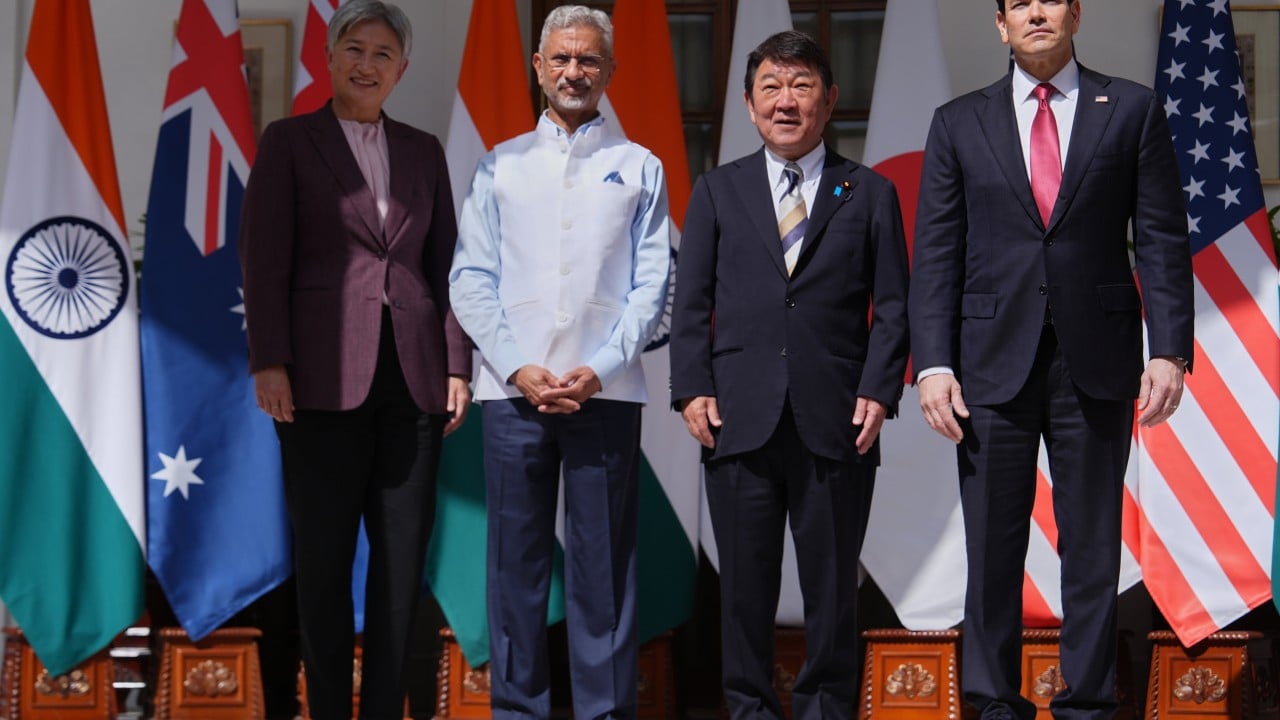
At a meeting of the Quadrilateral Security Dialogue, or Quad, in New Delhi last week, the foreign ministers of Australia, India, Japan and the United States – Penny Wong, S. Jaishankar, Toshimitsu Motegi and US Secretary of State Marco Rubio, respectively – agreed to undertake the bloc’s first joint infrastructure project.
“We are going to be partnering on issues of port infrastructure, in particular in response to insufficient port capacity in the Pacific islands. We are announcing plans to work with Fiji,” Rubio said.
Wong said the project was the bloc’s strongest commitment to providing high-quality infrastructure in the Pacific region.
The meeting marked a revival of the Quad, which was founded in 2007 to counter China’s regional influence, after the bloc failed to agree on a leaders’ summit in Delhi last year, primarily due to tensions between US President Donald Trump and Indian Prime Minister Narendra Modi over Washington’s tariffs against India.
Analysts say Trump’s lack of interest in the Quad signals his transactional approach to foreign policy, favouring bilateral agreements over multilateralism.
Welcoming the Quad’s latest initiative, Fijian Prime Minister Sitiveni Rabuka said the project was aimed at national economic development rather than for military purposes, according to local media reports.
Hideyuki Shiozawa, director of the island nations’ division at the Sasakawa Peace Foundation in Japan, said the Fiji port project was critical to the economic security of the country and the Pacific region.
However, he added that the Quad should decide soon on a partner to provide funding to Fiji for the project.
“It is not in the interests of Japan, the US and Australia for China to secure rights to the port,” Shiozawa said. “If developed nations fail to respond, Fiji will have to consider taking out a loan from China.”
Beijing has criticised the Quad for trying to contain China’s development. Last week, it said that countries should cooperate and contribute to regional peace, stability and prosperity, and not target any third party.
“We also do not support the formation of exclusive cliques or bloc confrontation,” China’s foreign ministry spokeswoman Mao Ning told a daily press conference.
Authorities in Fiji are looking to develop facilities for commercial and cruise ships to turn the port sector into a major economic driver.
While many container ships, oil tankers and large cruise ships call at the current port in Suva, its capacity is limited, and this is constraining Fiji’s economic growth, according to Shiozawa.
In 2023, Fijian leader Rabuka met Chinese President Xi Jinping in San Francisco, where he proposed that Beijing be involved in the modernisation of Fiji’s ports, shipyards and maritime infrastructure.
He also travelled to China in August last year and visited the Xiamen Port Authority in Fujian province to study Chinese port technologies and explore potential maritime collaborations.
No construction or investment agreements emerged from Rabuka’s visits.
In February, Fiji signed a deal with the US Millennium Challenge Corporation to conduct studies on US-backed infrastructure projects funded by grants.
Ying Zhu, co-director of the University of South Australia’s Centre for Enterprise Dynamics in Global Economies, said that while Fiji welcomed support for infrastructure development, it would expect the Quad to commit to the port’s completion.
Given the current economic difficulties faced by the Quad’s members and their divergent policy priorities, coupled with Trump’s indifference to the bloc, its offer to Fiji might be “another empty promise”, he said.
In contrast, China has already been heavily involved in Fiji’s development for years through grants and concessional loans under the Belt and Road Initiative, including for healthcare facilities, sporting venues and roads.
“For China, it does not matter, given that it has been developing all kinds of infrastructure there,” Zhu said. “China has already built a solid foundation there and does not worry about any new initiative there.”
Michael Field, editor of the South Pacific Tides newsletter, has questioned the manner in which the Quad decided on the port development in Fiji.
Writing on May 29 in the Devpolicy Blog from the Australian National University’s Crawford School of Public Policy, he said Fiji was neither represented at the meeting nor “entirely clear on what had been decided in its name”.
“To many in the Pacific it looks uncomfortably familiar: distant powers gathering behind closed doors, shaping regional futures and expecting island nations to accept decisions already made elsewhere,” Field argued.
“What is not clear here at all is what this means to Fiji’s sovereignty, what’s in the fine print and the terms and conditions … What’s the price Fiji pays for a Quad port?”
Guy Boekenstein, an adviser to governments and companies, has also raised doubts about the Quad’s capacity to deliver the port project, saying that extensive planning and governance were critical and should not be “an afterthought once political announcements have been made”.
“For initiatives like the Fiji port project to succeed, governments must integrate private-sector capability from the outset,” Boekenstein wrote in Defence Connect, a market intelligence platform for Australia’s defence sector.
“These are not areas where government bureaucracies traditionally excel.”