
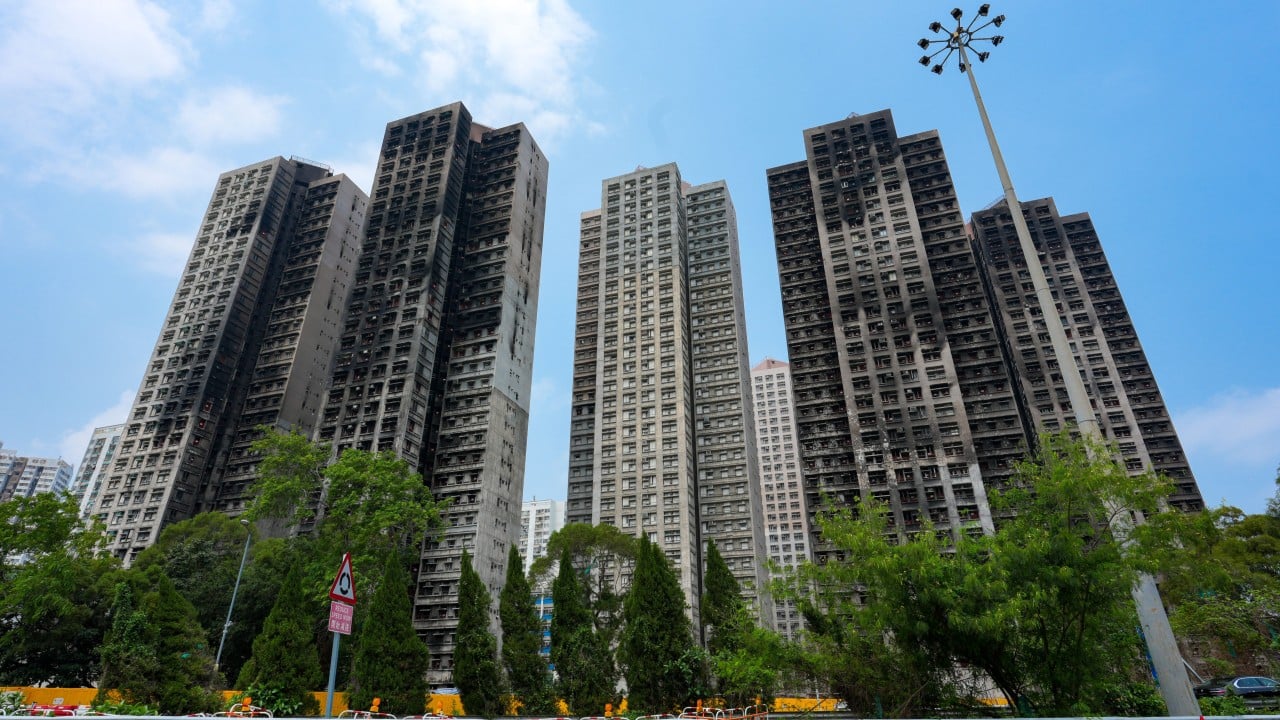
A Labour Department official has told an inquiry into Hong Kong’s deadly Tai Po inferno that the temporary removal of fireproof windows from emergency passages in the blaze-hit estate complied with occupational safety protocols, triggering questions on whether the interests of workers and residents are at odds.
The inquiry also heard on Tuesday that a department officer had misled Wang Fuk Court residents by claiming the fire resistance of renovation material was outside the purview of the law, and that the risk of scaffolding mesh being set alight was low.
The inferno that ravaged seven of eight buildings at Wang Fuk Court for 43 hours from November 26 last year was the deadliest in Hong Kong since 1948, killing 168 people and displacing nearly 5,000.
The legal team for the independent committee investigating the fire previously attributed the tragedy to six “human factors”, including the replacement of windows with movable wooden boards at the towers’ rear staircases.
Labour Department senior occupational safety officer Li Man-pong said temporary openings in the eight 31-storey buildings at Wang Fuk Court allowed renovation workers easy access to scaffolding, as a code of practice barred them from climbing along bamboo ledgers.
Committee chairman Mr Justice David Lok Kai-hong asked whether existing regulations fairly balanced workers’ welfare and residents’ safety.
“Our preliminary finding is that smoke entered the buildings through the openings and prevented residents from escaping,” Lok said. “That leads to a very big problem: are the interests of workers and residents at odds with one another?”
Li said the practice did not violate the Occupational Safety and Health Ordinance, but noted it could be in breach of other fire safety regulations.
Chief occupational safety officer Murphy Yuen Tsz-lok said temporary openings were not mandatory under the current legal framework and workers could access scaffolding by “many means”.
While the Construction Sites (Safety) Regulations require contractors to keep fire passages in good condition, Yuen cast doubt on their applicability to Wang Fuk Court’s rear staircases. He said the regulations targeted violations at construction sites but not residents’ homes.
Li, who supervises the ordinance’s enforcement in the eastern New Territories and Kwun Tong, said the department had issued three summonses to renovation contractor Prestige Construction and Engineering and scaffolding subcontractor Gain Profit Shed Industry during the Wang Fuk Court project.
Those charges arose from the firms’ inability to take reasonable steps to prevent workers from falling while working in high places.
The department had also received repeated complaints about employees smoking while working on scaffolding after renovations at the estate began in July 2024, but it had taken no enforcement action apart from issuing warning letters, the committee heard.
Two complaints, dated July and October 2024, could not be justified partly because “no workers were found smoking on the site during [the] visit”.
While officers found a few stubs left in the estate’s common area during the October visit, they could not ascertain whether they were left by renovation workers or others.
Lam Sau-ching, then an occupational safety officer for minor renovation and maintenance works, said the department could not take action if workers merely smoked in an open area without any flammable material nearby.
Li said the department did not consider the polyfoam boards that the contractor used to seal windows as a fire hazard under its jurisdiction, noting that they were combustible but not flammable.
Regarding the use of substandard scaffolding mesh at Wang Fuk Court, Lam said the department did not realise Prestige had submitted two identical reports purporting to show the netting’s fire retardancy in response to separate requests for information in July 2024 and November 2025.
Lam said she and her colleagues focused on the test results rather than the documents’ authenticity, adding that they lacked the professional knowledge to decide if the reports’ conclusions were reliable.
Barrister Lee Shu-wun, representing the committee, also highlighted the department’s reply to a scaffolding mesh complaint, in which Lam suggested that existing legislation did not require renovation material to be fire-resistant.
“The protective sheets on scaffolding are intended to restrict the area in which falling objects may land and to protect people from being hit by falling objects, tools or waste,” said the email, dated October 4, 2024.
It also highlighted the absence of “hot works” – procedures that produce heat – on bamboo scaffolding and the availability of fire extinguishers at the site.
“Therefore, the risk of a fire on scaffolding mesh is relatively low,” the email concluded.
Lam acknowledged the department’s code of practice for bamboo scaffolding safety required protective nets to be capable of withstanding fire, saying her reply could have been more “accurate” and “comprehensive”.
“Not accurate enough is not the right way to put it. It was incorrect,” Lee said, adding that the department’s response would have misled the complainant. Lam agreed.
Four Fire Services Department witnesses are expected to testify when the hearing resumes at City Gallery in Central on Wednesday.