
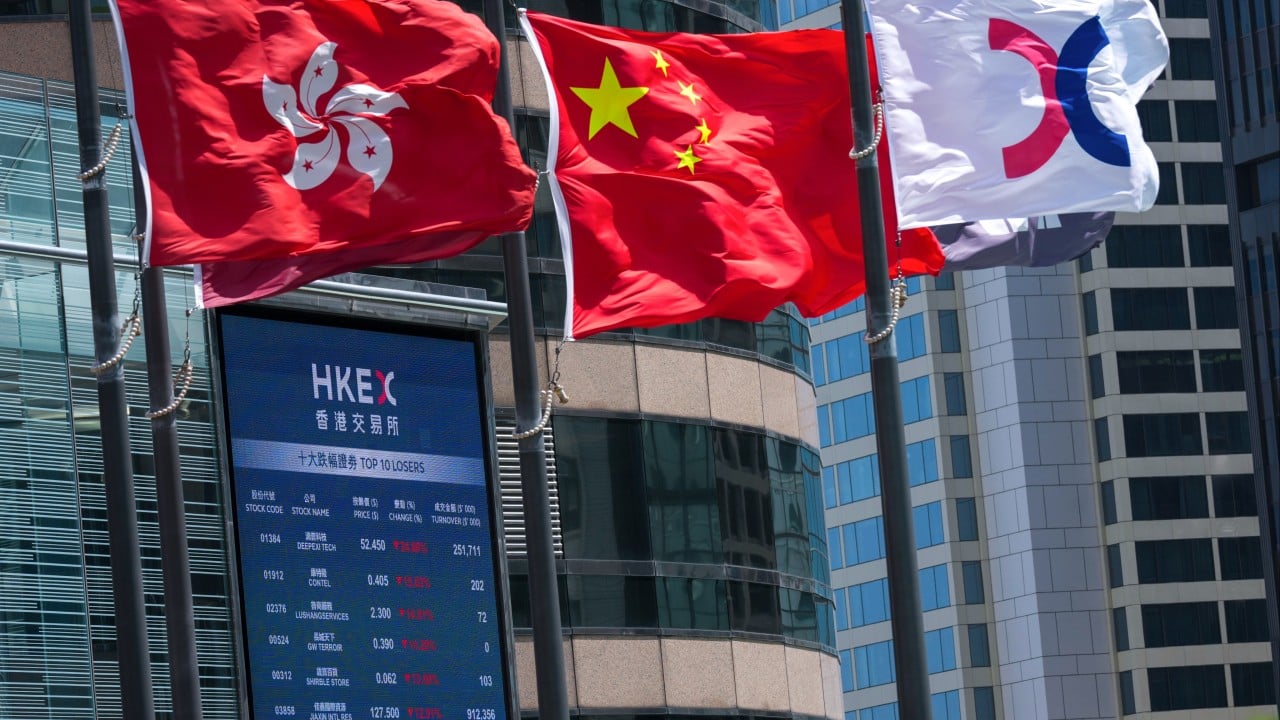
A long-standing pricing gap between the mainland China-listed and Hong Kong shares of dual-listed companies has narrowed – and in some cases reversed – as global investors re-rate China’s technology companies.
The Hang Seng AH Premium Index, a widely watched gauge of the valuation gap between dual-listed companies’ A shares trading on mainland exchanges and their H shares in Hong Kong, has remained below 120 in recent sessions, down sharply from a high of 157.89 in February 2024.
The shift has been most evident in so-called hard-technology names, where market leaders Contemporary Amperex Technology Limited (CATL), Montage Technology and GigaDevice Semiconductor have seen their A-H premium turn into an H-A surcharge.
EV battery maker CATL’s H-A premium has narrowed sharply in recent sessions, but its H shares stood at a premium of about 43 per cent to its A shares as of Tuesday’s close. For Montage Technology and GigaDevice Semiconductor, the H-A premiums were 14 per cent and 25 per cent, respectively.
The shift underscored a structural change in how global and domestic investors were pricing Chinese assets, analysts said, rather than a simple short-term arbitrage opportunity.
“This is in line with [Beijing’s] A+H policy introduced earlier, which encourages high-quality and promising mainland companies to list in Hong Kong,” said Kenny Tang Sing-hing, chairman of the Hong Kong Institute of Financial Analysts and Professional Commentators.
The A+H framework encourages leading mainland companies, particularly in strategic sectors such as technology and advanced manufacturing, to tap offshore capital markets as part of a broader push to improve pricing efficiency and attract global investors.
Tang said Hong Kong’s role as an international market allowed valuations to be anchored to global investor participation, rather than being dominated by retail and domestic institutional flows in mainland China.
“Valuations set by international funds tend to carry more reference value,” Tang said. “That’s why over the past year we’ve seen stronger and higher-quality companies being pushed to list in Hong Kong, attracting global investors and lifting their valuations. In some cases, that has even led to H shares trading at a premium to A shares, such as CATL.”
He added that southbound inflows had also played a role, as mainland investors seeking exposure to these companies had increasingly turned to the cross-border Stock Connect channel to buy H shares, further supporting valuations in Hong Kong.
Net inflows via the Stock Connect programme reached about HK$1.4 trillion (US$179 billion) in 2025, with momentum extending into 2026, according to exchange data. The surge in mainland capital has helped lift Hong Kong’s average daily turnover to around HK$2.4 trillion, up sharply from about HK$1.3 trillion in 2024.
Kenny Ng Lai-yin, a strategist at Everbright Securities, said the narrowing or reversal of the premium reflected both structural and cyclical factors.
“Newly listed technology companies in Hong Kong have performed strongly, which has helped pull down the premium index,” he said, adding that the trend could persist as global investors tended to assign higher valuations to leading tech firms than their mainland peers.
Market dynamics also played a role in the convergence of valuations, he added.
“Both mainland and Hong Kong markets have been in a recovery cycle in recent years, but Hong Kong tends to show stronger momentum and larger swings,” Ng said. “In an upcycle, gains in Hong Kong are usually more pronounced.”