
Modern military supremacy – from stealth jets to hypersonic missiles – hinges on micron-scale “super powders” engineered using precision mills.
A new Chinese facility unveiled last week – described as the largest in the world – may give the country a critical edge in this field.
The mill in the southern province of Guangdong uses new technology that the company behind it said was 10 times more efficient than older methods and allowed for the industrial scale production of these powders.
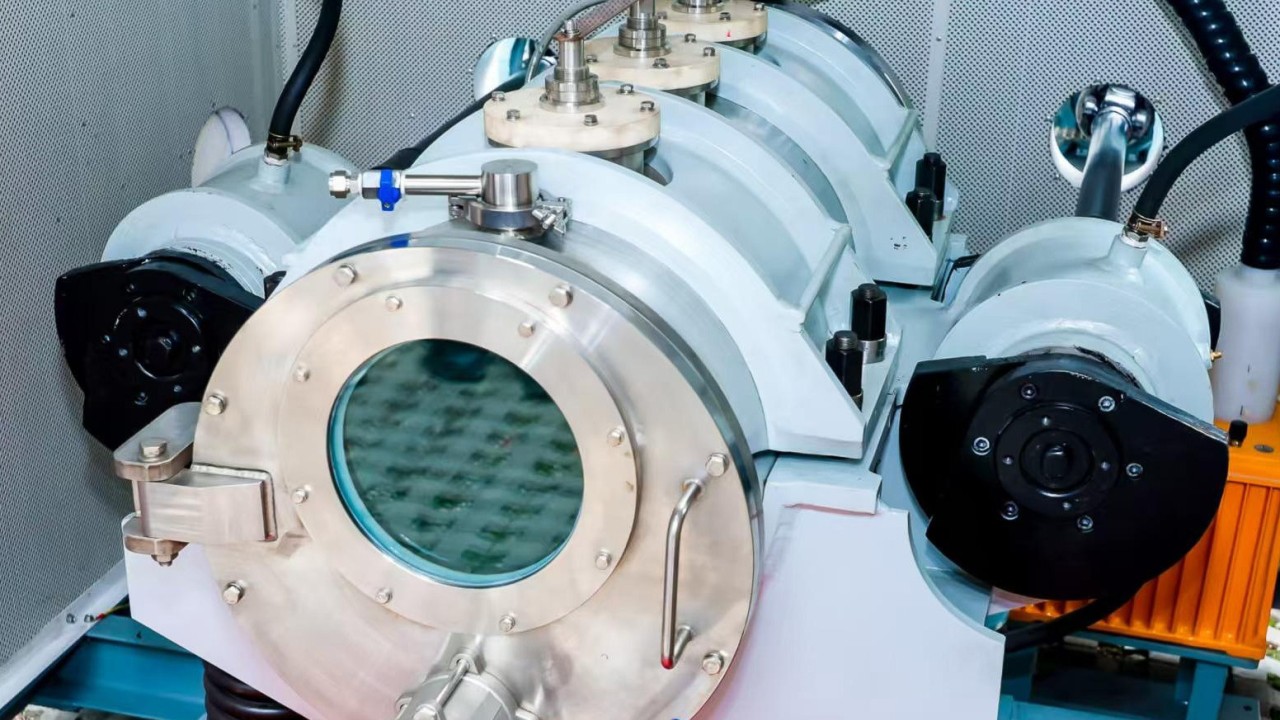
At first glance, these mills look like crude spinning drums that are loaded with heavy balls made from a range of materials, such as metals, graphite or polymers.
But they are essential precision tools that play a key role in producing the most advanced defence technology, such as the radar-absorbing coating on stealth aircraft made from magnetic iron flakes ground into microscopic slivers.
Jet engine turbine blades are also made from metal powders that are pressed and heated to remove every hidden flaw.
These powders are also widely used in civilian technologies ranging from electronics to energy storage.
Guangzhou Huaxin Material Innovation Technology Company unveiled the new facility, which it said was the world’s first 100-litre plasma ball mill, in Shunde city last week.
The traditional high-energy milling process used by leading manufacturers in the United States and Europe – Germany in particular – relies purely on mechanical force to grind the powders.
But there are practical limits to how big these mills can be because as the mechanical energy increases, so do the stresses on the chamber.
The process also introduces impurities into the product, something the new process is designed to avoid.
“Foreign systems push mechanical energy to the limit, which makes scaling difficult,” Yang Xiaoping, the company vice-general manager, said on Monday.
“We add plasma – using ‘electricity’ to boost energy – so we can go bigger without breaking the machine,” he added.
Plasma is an ionised conductive gas that is used in the complex milling process developed over two decades by a team led by Professor Zhu Min at South China University of Technology.
It is designed to make the balls easier to grind down by using high-energy electrons and transient thermal effects that weaken particles from within and fragment them more efficiently.
According to data provided by Huaxin, grinding efficiency has increased nearly tenfold with the help of plasma.
More importantly, the newly released 100-litre (26-gallon) system represents a shift from laboratory-scale experimentation to industrial production.
“When the 20-litre model was released, customers immediately said it was too small,” a company representative said. “They asked for at least 100 litres.”
The US is already falling behind China in the production of high-end defence equipment such as new generation radar, heavy stealth aircraft and hypersonic weapons – domains where advanced powder processing is an increasingly critical choke point.
While the US and Germany retain deep expertise in materials science, no equivalent to the large-scale plasma-assisted ball milling systems is known to exist.
Powder-based processes also underpin a vast industrial ecosystem in the civilian sector.
While specific clients cannot be named due to confidentiality agreements, the company confirmed collaborations with leading firms in fields such as renewable energy, thermal management and electronic materials.
In practice, this could affect everything from advanced battery chemistries – such as silicon-carbon anodes and solid-state electrolytes – to high-frequency communication components used in 5G and 6G systems.
If high-performance powders can be produced more efficiently, at scale and at lower cost, the downstream ripple effects could reshape industries ranging from semiconductors to aerospace.
Yang said the company had already begun expanding overseas, adding: “Now we also have some exports. Last year, we had exports in Singapore and South Korea. This year, we are making plans for exports in some other places.”