
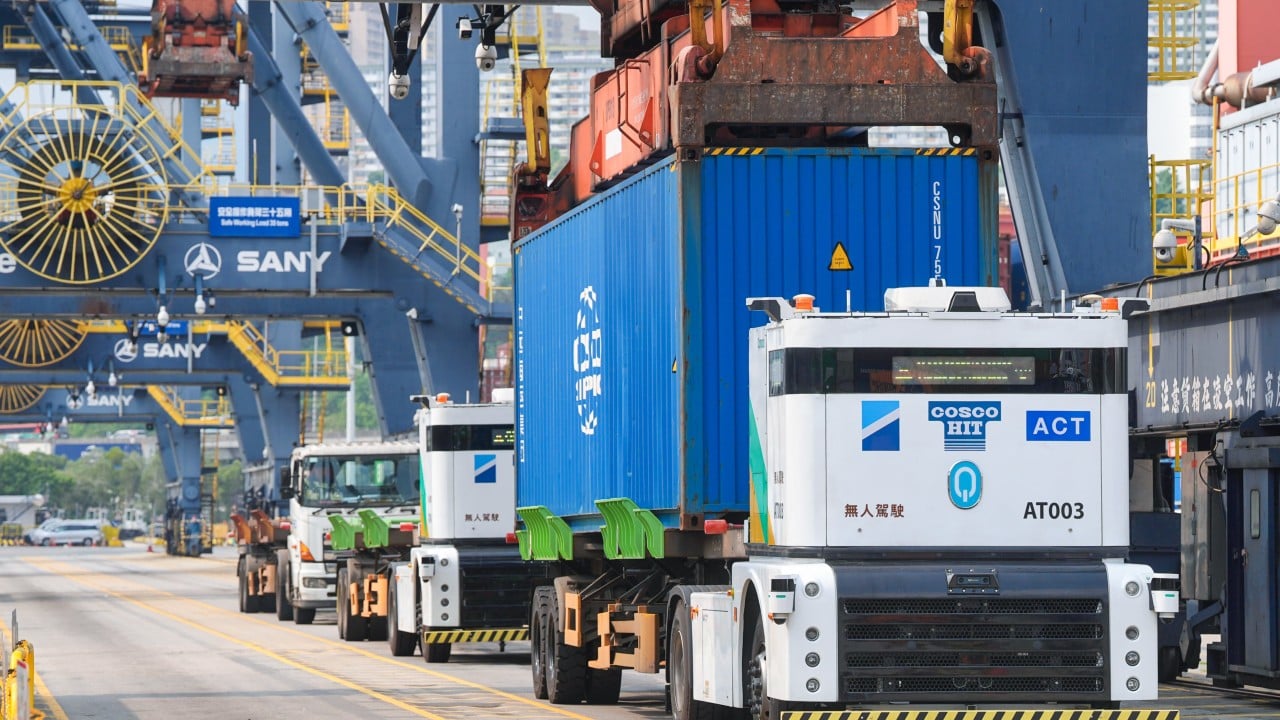
Hutchison Port Holdings Trust has deployed Hong Kong’s first AI-powered driverless trucks, a move the container terminal operator said could help tackle a chronic manpower shortage and improve efficiency.
The trust, affiliated with Hutchison Ports – a subsidiary of CK Hutchison Holdings, controlled by billionaire Li Ka-shing’s family – on Tuesday invited media to view a fleet of six electric autonomous trucks at Kwai Tsing Container Terminal 4. The fleet was launched in January.
“Hong Kong has been affected by a labour shortage across sectors. In particular, the supply of commercial vehicle drivers has been relatively very tight and our port is no exception,” said Raymond Lam Wai-kui, director of operations at Hong Kong International Terminals, a member of Hutchison Port Holdings Trust.
“Introducing these driverless vehicles has helped us solve some of the issues brought about by a manpower crunch. We aim to expand this initiative to meet daily port operations without affecting existing staffing.”
Lam added that since the start of the year, the six autonomous trucks have handled more than 8,000 container movements at Terminal 4.
He also said that a key feature of the new fleet is that the driverless trucks do not require a designated lane and could share the same roads as traditional human-piloted trucks, explaining that they are equipped with AI-driven double cameras, an advanced positioning system, and a laser radar to operate in “mixed mode” at the port.
The vehicles operate at speeds comparable to traditional trucks, using artificial intelligence algorithms to determine faster routes based on real-time traffic conditions, thereby improving logistical efficiency.
Lam stopped short of elaborating on the extent of the efficiency gains.
The trucks are centrally managed from a control centre and operated through a port management system and a fleet management system. These are supported by a dedicated 5G network that ensures rapid data transmission with low latency.
Lam said that if obstacles are detected, the system instructs the truck to slow down or stop. Additional safety features include an emergency stop bumper and an emergency halt button.
“There’s another safety net which is our container yard management system which connects to all CCTV of the port with high-resolution images. If we detect any abnormalities, the system would warn the fleet management system,” he said.
“Real-time calculations will then take place to see if the trucks would need route alteration or emergency halting,” Lam added. “There is a whole system to map the routes and monitor in real time to ensure every step is protected, safe and traceable afterwards.”
Lam said the trucks took about one hour to charge each day, adding that as the fleet expanded, replaceable batteries would be introduced, allowing charging when not in use, with battery swaps taking six to seven minutes.
Currently, more than 90 per cent of port logistics are handled by human-driven trucks.
Lam said the company planned to deploy driverless trucks across all terminals it operates.
The South China Morning Post reported earlier this year that autonomous driving could “erupt” across mainland China, potentially threatening the livelihoods of many workers, including taxi and ride-hailing drivers.
While the exact number of jobs lost to AI in the world’s largest labour market remains unclear, figures released by Chinese tech giant Baidu in November offer some insight.
In 2025, its self-driving taxi service Apollo Go recorded 250,000 weekly orders, with total rides worldwide exceeding 17 million.