
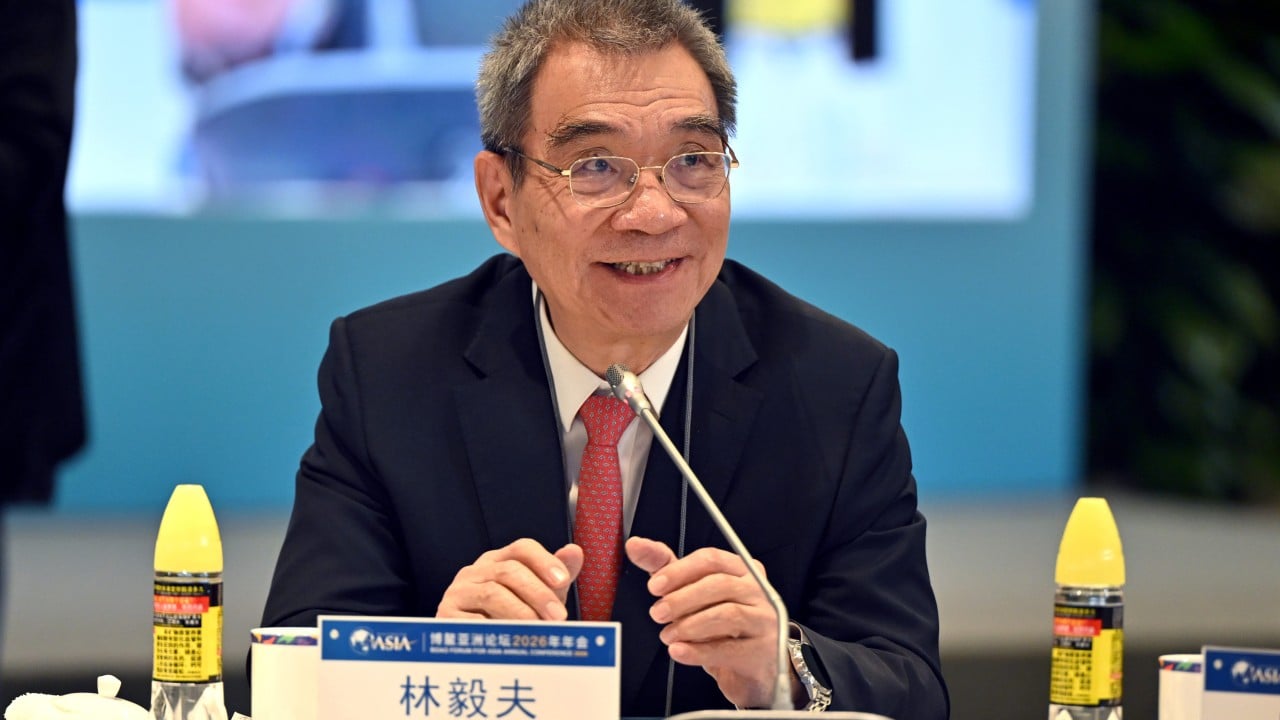
The West’s narrative of Chinese “overcapacity” is a double standard, said a former chief economist of the World Bank as he urged advanced economies to draw on “Eastern wisdom” rather than protectionism to navigate the rise of hi-tech competition.
Justin Lin Yifu, a prominent advocate of Beijing’s industrial policy, dismissed claims that China’s auto-export surge was a sign of industrial imbalance. Speaking at Hong Kong Chu Hai College, Lin drew a contrast with Germany to expose a logical inconsistency in the current Western rhetoric.
“[Western countries] say China became the world’s largest car exporter because of overcapacity, but if we look at which country has the highest share of auto exports – it is Germany,” Lin said during a question and answer session following his keynote speech at the college on Friday.
He noted that Germany exports about 4 million vehicles a year, accounting for roughly 80 per cent of its total production. In contrast, he said, China exports around 7 million vehicles, representing about 20 per cent of its output, with the rest absorbed domestically.
“If Germany’s ratio is taken as the benchmark, then China would be seen as having ‘undercapacity’, not overcapacity,” said Lin, who is now dean of the Institute of New Structural Economics at Peking University.
Lin’s remarks underscore the persistent debate over China’s industrial policies, which he has championed for decades. While these state-backed efforts have cemented China’s dominance in green technology and other fields, they have also fuelled accusations of “overcapacity” and dumping from major trading partners such as the United States and the European Union.
“A major issue for developing nations is that we often fall into the trap of adopting [Western] rhetoric,” he said, slamming the “overcapacity” talking point as a “complete double standard”.
While China admitted that “overcapacity in some industries” was a problem during a high-level conference in 2023 – and frequent mention has been made of neijuan, the excessive industrial competition that can lead to redundancies in supply chains – officials and state media have refuted charges from the US and EU that Beijing was weaponising its vast manufacturing power to disrupt global trade.
I think Western countries should learn from the wisdom of Eastern countries
Justin Lin Yifu, economist
Lin said Western economies tend to champion open markets when they hold a competitive advantage, but will shift their stance once developing countries become competitive enough to enter their markets, inventing new narratives to keep them out.
“But if you analyse it carefully through the lens of economics, these arguments are sophistry,” he said.
As China upgrades its industries, it will inevitably move into sectors where advanced economies once held a comparative advantage, resulting in Chinese products – with higher quality and lower costs – becoming more competitive, he added.
“I think Western countries should learn from the wisdom of Eastern countries,” he said, referring to Japan’s historical willingness to outsource labour-intensive industries to developing Asian neighbours to facilitate its own move into advanced manufacturing.
He called Germany “the most clear-headed” among the developed economies in navigating global competition, praising its willingness to welcome Chinese auto investments and technological partnerships, a strategy that mirrors how China built its own auto industry decades ago.
Earlier this month, the state-run Economic Daily similarly slammed any talk of “China shock 2.0” – a claim that has gained traction amid China’s record trade surplus last year – as a false narrative that mirrored earlier “overcapacity” discussions.
“This line of argument disregards the vast opportunities China’s development has created for countries worldwide, and seeks to pave the way for protectionist policies in certain countries by smearing China,” the newspaper said.