
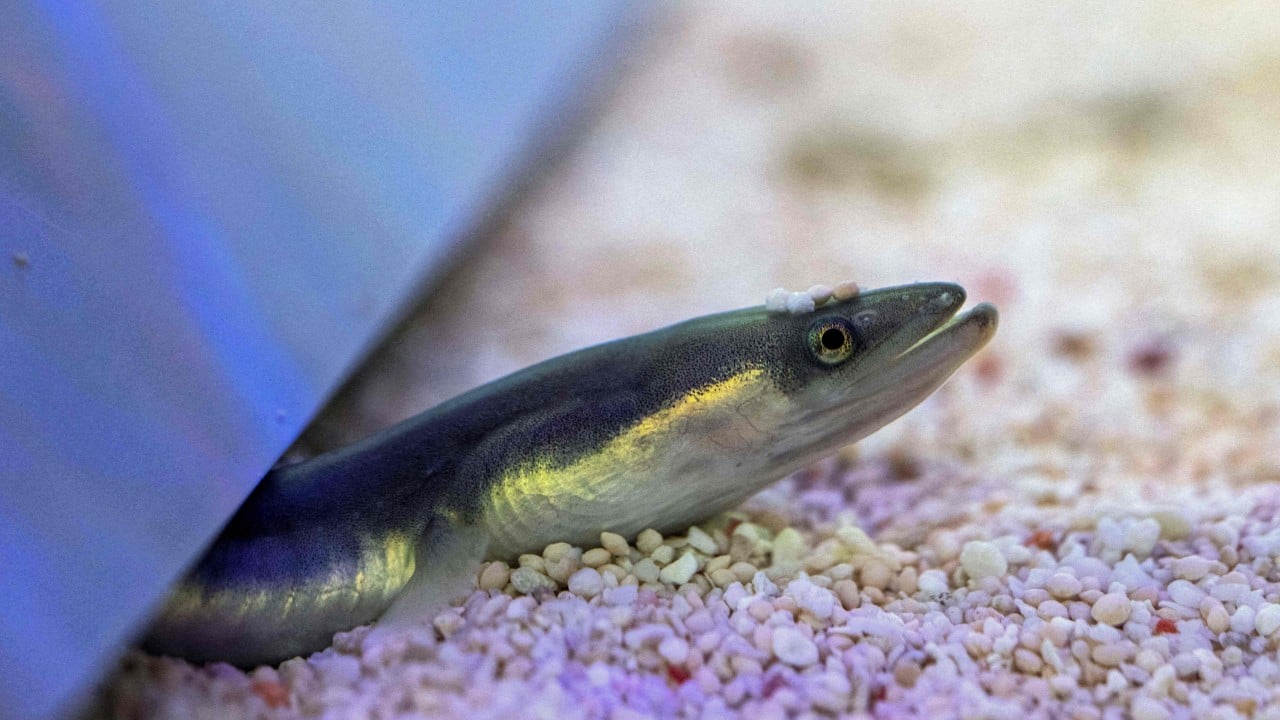
Researchers in China have replicated the epic journey of one of the world’s most fascinating migratory fish within the confines of an artificial pool, potentially saving it from extinction.
From hatching to maturity and spawning, eels undergo six stages of physical transformation over at least five years as they travel 6,000km (3,700 miles) from the ocean depths to freshwater rivers and lakes.
Zhao Feng and his team from the Chinese Academy of Fishery Sciences used satellite-tracking technology to analyse environmental factors and feeding patterns of adult eels in their natural habitat before achieving artificial breeding in the rearing workshop.
“Through three to four months of refined nutritional enhancement and environmental simulation, we successfully cultivated over 3,000 high-quality eel breeding parents and over 3 million fry,” Zhao told China Science Daily in an interview published on April 14.
The project, to develop high quality breeding and artificial reproduction technology for eels, is a national key research and development programme launched in December 2024, and passing preliminary acceptance in March at two eel testing bases, in Hainan and Fujian.
China accounts for 75 per cent of the world’s farmed eels and exported more than 65,000 tonnes of the fish and associated products in 2025, according to customs data. However, without artificial insemination, the farms are stocked with fry sourced from net fishing.
The latest breakthrough marks a key step for China, which is making a huge effort to delay – or even reverse – the threatened extinction of this species through the full-scale artificial breeding of eels.
The International Union for Conservation of Nature classified the European eel as critically endangered in 2007, prohibiting the unapproved transnational trade of eels and eel fry. In 2014, Japanese and American eels were listed as endangered.
Japan is the largest consumer of eels, with the Japanese eating 150,000 tonnes each year accounting for 70 per cent of the global catch, despite representing just 1.5 per cent of the world’s population, according to data from the China Eel Network.
In Japan’s earliest poetry collection, the Manyoshu from about AD759, there is a record of eel being eaten as a tonic. Grilled eels, brushed with a soy-based glaze and skewered, were popular during the Edo period, around 1800.
Japanese eels (Anguilla japonica) deposit their fertilised eggs at the bottom of the Mariana Trench’s underwater mountain range, the deepest known part of the world’s oceans.
From November each year, the hatched eel fry drift northwards from the South Pacific, passing along China’s coastlines until they reach the Korean peninsula and Japan, entering freshwater rivers and lakes before returning along the same path to spawn.
European and American eels have a similar long-distance pattern, originating from the Bermuda Triangle in the Atlantic Ocean’s Sargasso Sea.
Increased fishing of these endangered species has meant that wild eels and eel fry globally are now at less than 20 per cent of their peak levels, an issue that potentially could be completely resolved by Zhao’s project.
At Jimei University’s aquaculture experimental site in Fujian, where the project is based, various workshops are arranged in sequence, with eel broodstock swimming in the aquaculture system in a factory.
In the maturation workshop, the researchers carefully control light, salinity and water flow conditions to accurately replicate the ecological signals of the eels’ natural reproduction.
In the rearing workshop, newly-hatched fry are suspended in pond water, with the dark conditions of the deep sea simulated by a black cloth covered with a light screen, according to the China Science Daily report.
Previous research on the artificial breeding of eels has mainly focused on hormone-induced artificial insemination. While fertilised eggs can be obtained this way, the method has many limitations, including unstable gamete quality, low fertilisation rates and low fry survival rates.
A core breakthrough was achieved by assisting eels in natural spawning and fertilisation through the natural environment, Chen Shixi, a professor with Jimei University’s fisheries laboratory, told Fujian Daily in an interview published on April 9.
“In a controlled indoor system that simulates natural environments, we successfully induced synchronous development to sexual maturity in male and female parent fish through precise hormonal regulation and management of environmental factors,” he said.
“They completed the entire process of courtship, chasing, spawning and fertilisation spontaneously, just as they would in the ocean.”
The team has achieved stable multiple-batch artificial insemination, accumulating high-quality fertilised eggs and hatching a large number of fry, providing ample material support for subsequent large-scale cultivation and research of fry, the Fujian Daily reported.
The core technical challenge in achieving fully artificial breeding of eels is to initiate feeding in fry.
According to the expert group’s acceptance report, a portion of the 3 million fish fry cultivated for the project successfully reached the stage of opening their mouths and feeding.
“In the next step, our team will focus on key technological aspects such as the large-scale survival of fry and metamorphosis, striving to overcome the global challenge of fully artificial breeding of eels as soon as possible,” Zhao said.
Passionate about science? Dive deeper with the Dark Matters newsletter, a weekly in-depth analysis on China’s rise in science, technology and military that goes beneath the surface. Sign up for free now.