
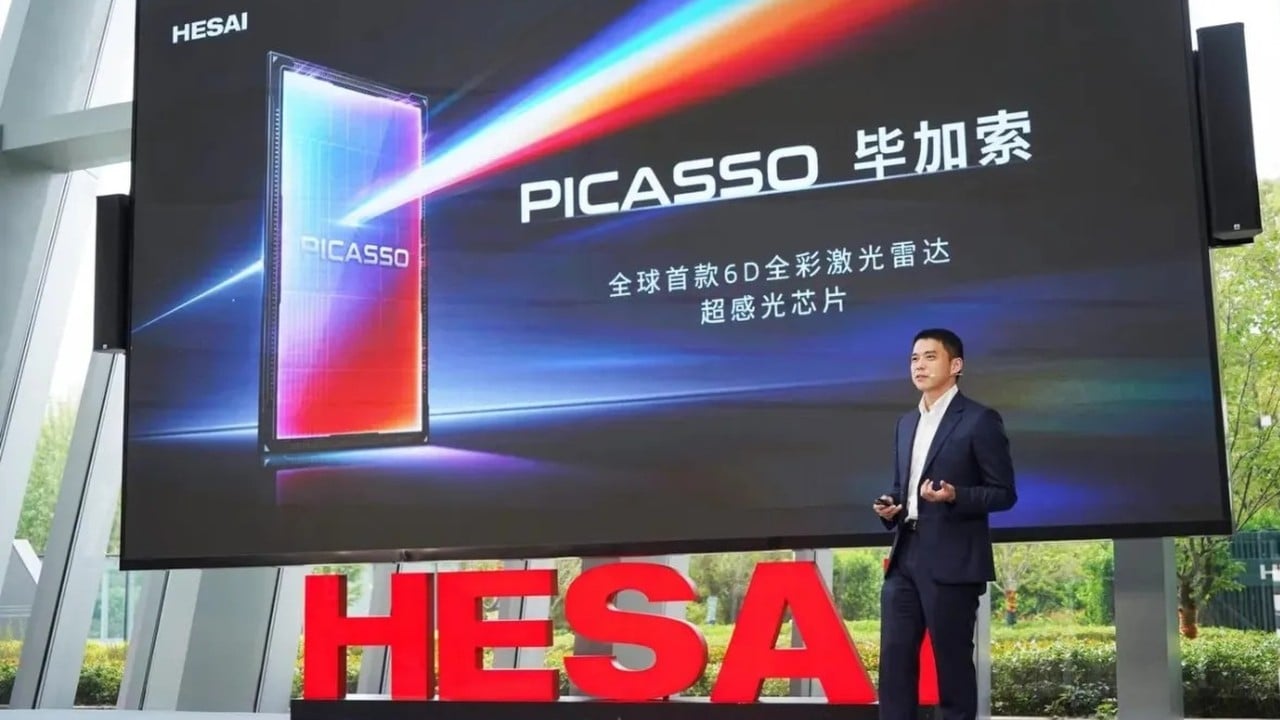
Hesai Group, the world’s largest maker of vehicle lidar sensors, introduced technology it said would raise autonomous driving features to a new level by detecting colour to improve the reliability of object identification.
The Shanghai-based maker of light detection and ranging sensors said its 6D full-colour platform would deliver lidar sensors with world-leading capabilities in ranging and small-target identification. 6D refers to the sensors’ ability to detect the X, Y and Z coordinates of an object, plus its reflectivity, velocity and colour.
Expected to hit the market in the second half of this year, the company’s ETX lidar sensors would be the first of their kind, according to Hesai CEO David Li Yifan.
“This is not some kind of market hype,” he said in a media briefing on Friday. “It is a fundamental innovation, something that no one I know of has ever done before.”
He added that Hesai would prioritise “zero-to-one innovative breakthroughs” amid an intensified tech race in the global automotive industry, where key players were racing to develop driverless cars.
“The technology eliminates the need for complex stitching or inference, meaning the autonomous driving system no longer needs to ‘guess’ when identifying critical coloured objects like traffic lights, lane lines or construction signs,” Deutsche Bank said in a research note over the weekend. The capability would “significantly enhance” the spatial intelligence of artificial intelligence world models, it added.
Hesai did not disclose which carmakers would take delivery of the first batch of ETX lidars. Li said the company was determined to bring down costs by increasing manufacturing capacity and capabilities.
Hesai said the ETX sensors would work with its self-developed Picasso system on chip, which would also be used in the company’s new Kosmo handheld device, described as a “physical AI eye” for capturing and recording spaces in 3D.
Hesai, which counts all of the top 10 Chinese carmakers as its clients, posted a net profit of 435.9 million yuan (US$63.9 million) for 2025, swinging from a net loss of 102.4 million yuan a year earlier. That made Hesai the world’s first automotive lidar sensor maker to report a full-year profit, driven by Chinese carmakers’ surging demand for the devices, crucial in the development of self-driving cars.
The company’s lidar deliveries in 2025 soared 223 per cent from a year earlier to 1.62 million units. Hesai plans to double its annual capacity to 4 million units this year.
Chinese assemblers and automotive supply-chain vendors currently stood at the vanguard of electric vehicle (EV) technology and production, buoyed by government support and consumers’ willingness to embrace innovation, according to analysts.
Nearly all major carmakers in China are actively developing cars with “hands off” self-driving features to gain an edge in the cutthroat market.
In December, Beijing gave the first carmakers the go-ahead to build EVs with Level 3 (L3) autonomous driving capability. On an international scale from L0 to L5, an L3 autonomous vehicle can operate independently under predefined conditions, although the driver must remain ready at all times to take control if required.
Pilot L3 operations have started on designated urban roads in southwest China’s Chongqing and on highways in Beijing, with more approvals expected to follow.