
A new study from mainland China’s internal security forces offers a glimpse into a future where urban unrest is managed by autonomous machines instead of police in riot gear.
In a scenario laid out by engineering experts from the People’s Armed Police Force (PAP), a crowd – incited by rumours following a military takeover of a large city – gathers in a central square to assault key government installations.
Their protest meets a swift response: roadblocks are suddenly deployed, cutting off their advance. Key instigators in the crowd are swiftly identified and captured.
Cut off from the internet and unable to broadcast their cause, the demonstrators eventually disperse on their own.
Throughout the entire ordeal, they do not confront a soldier or police officer in person.
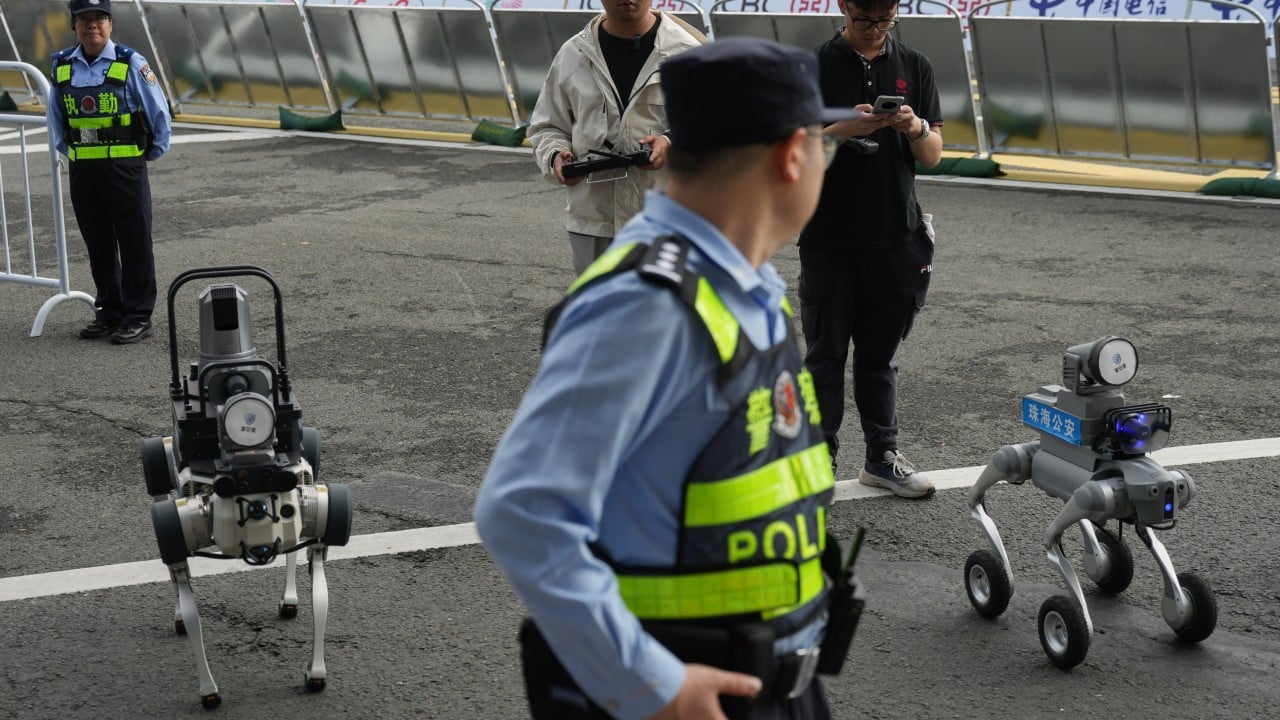
All reconnaissance, containment, arrests, and even psychological operations are executed by a collaborative swarm of drones in the sky and uncrewed armoured vehicles and robot dogs on the ground.
The detailed exercise, published this month in the mainland Chinese peer-reviewed journal Command Control & Simulation, marks a notable shift. While the PAP has historically emphasised human-machine teamwork, this paper suggests a growing interest in operations that rely almost entirely on intelligent machines to quell civil unrest.
This approach could help authorities avoid the kind of bloody, politically costly crackdowns that have scarred societies in the past, according to some security experts not involved in the study.
The paper, led by Du Bo of the Engineering University of PAP, uses the allegorical terms “Red Force” and “Blue Force”, but is clearly set in a post-reunification Taiwan, referring to Taipei as “New City”.
The scenario describes “external powers” inciting violence to “delay the Red Force’s unification process”.
In response, the Red Force employs “intelligent unmanned combat methods” to conduct “stability maintenance and control operations”.
The proposed system operates in a fully autonomous, four-phase sequence involving reconnaissance, blockade, cognitive warfare and arrests, all of which are coordinated by an AI command loop.
Human supervisors remain off-site, setting ethical boundaries rather than issuing tactical commands.
The unmanned units operate on a principle of highly specialised “division of labour” within a seamlessly integrated network.
Reconnaissance units act as the “eyes”, scanning crowds, while cognitive warfare units serve as the “voice” and “jammer”, broadcasting messages and blocking communications.
Blockade units form a mobile “shield” using physical barriers, and arrest units function as the precise “fist” to detain targets.
Composed of agile aerial drones, ground-based armoured vehicles and robot dogs, arrest units are equipped primarily with non-lethal capture tools, such as nets and tasers, and are tasked with surgically detaining pre-identified agitators.
While operations are autonomous, the authorisation of arrests remains a human decision.
Collaboration between human and robot team members is enabled by real-time data sharing.
For instance, once a reconnaissance drone identifies a ringleader, it can simultaneously alert a cognitive unit to jam local cell signals, preventing video uploads, while directing an arrest unit to move in, all coordinated faster than human reaction times.
However, the transition from academic theory to real-world application could face significant hurdles.
A Beijing-based expert noted that the core AI challenge was reliably distinguishing a violent instigator from a panicked bystander in a dense, chaotic crowd.
Errors in target recognition could lead to machines harming innocent civilians, raising major ethical and accountability questions, he said.
Furthermore, the centralised AI system and its communication networks would be prime targets for hacking and electronic warfare, posing a major technical vulnerability.