
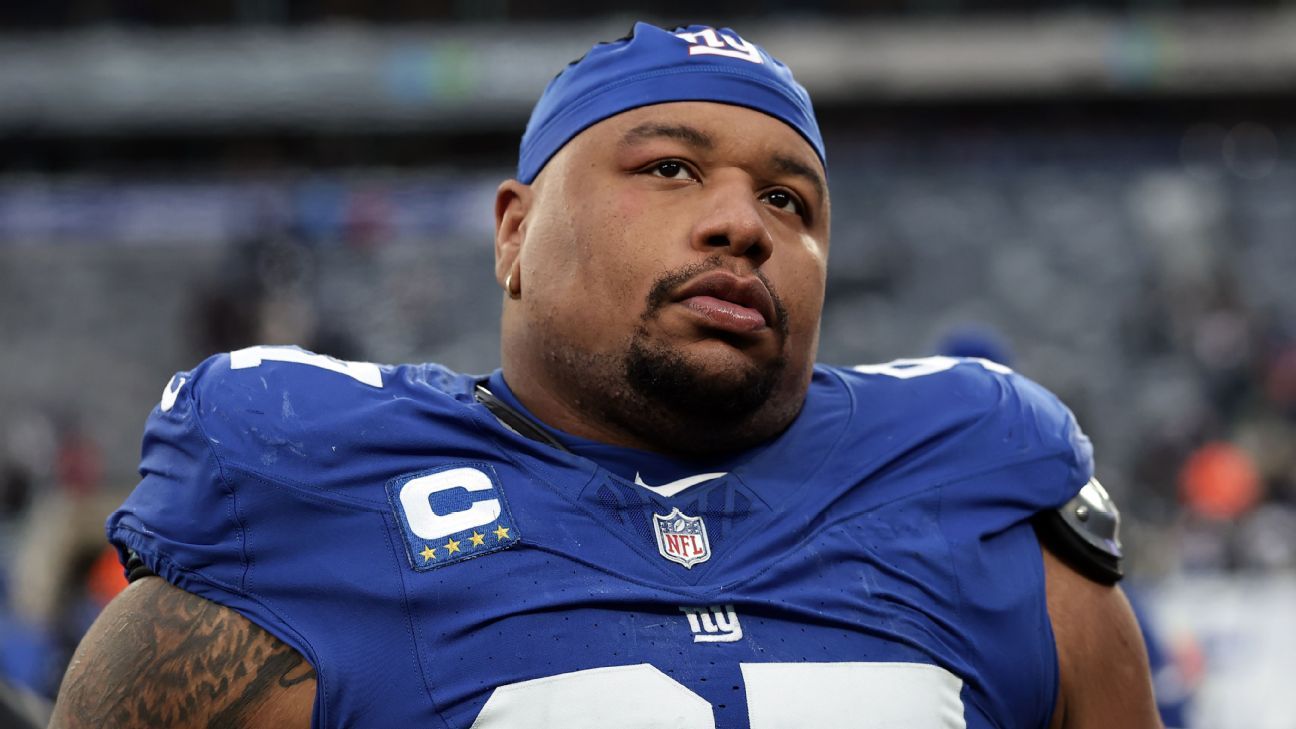
When I was putting together my trade tiers column over the summer and listing all the players who might land a first-round pick or more via a deal, Dexter Lawrence II was the very last cut. The Giants defensive tackle was a preeminent force on the interior and coming off a nine-sack season, but there were plenty of coverage sacks or secondary pressures factored into those totals, and Lawrence was already deep into his second contract, a point at which teams around the league had grown reluctant to trade first-round picks for even standout players.
Well, the game has changed. We've seen organizations around the NFL establish and pay a new premium for veteran defensive linemen. Even leaving Micah Parsons' deal with the Packers aside, the Cowboys sent first- and second-round picks to the Jets for Quinnen Williams. The Ravens agreed to send two first-round picks to the Raiders for Maxx Crosby before walking that deal back for injury reasons.
And on Saturday night, the Bengals stunningly became the latest team to go over the top for a veteran lineman, sending the 10th pick to the Giants to add Lawrence to their defensive line. The 28-year-old Lawrence had reportedly sought a new deal with New York, but once the two sides weren't able to find common ground, the Giants pivoted to the trade market.
What they received, frankly, is shocking. There's a reason that the reports on social media from NFL insiders had to include "straight up" to confirm that there wasn't a second-round pick or something else substantial heading back to Cincinnati as part of this deal. This is a massive return, one that would have seemed completely stunning to me a year ago, even given that Lawrence was coming off a better season. If we look at the big takeaways from this trade, I have to start there.
Jump to a takeaway:
The trade paradigm has shifted
The league doesn't like this draft
The Bengals see Lawrence as a game-changer
The Bengals want Burrow to be happy
Lawrence is now the fourth prominent defensive lineman to be included in a trade for a first-round pick over the past nine months after Parsons, Williams and Crosby (whose deal admittedly didn't come to fruition but still gives us a sense of how he was valued). The Parsons trade doesn't really belong with the other three, given that he was a younger player who hadn't even signed his second contract, let alone played through part of that deal.
The Cowboys' trade for Williams is really the moment when what NFL teams were willing to pay to acquire star defensive linemen midway through their second contracts shifted. It's impossible to say whether the Williams trade was the first example of that new world or whether it was the actual trade that caused prices to go up, but it generated a return that seemed out of line with what teams had been willing to give up in exchange for players with this level of experience, as well as wear and tear. Remember that the Bengals hadn't been able to land a first-round pick last offseason as they looked to trade Trey Hendrickson, who was coming off a 17.5-sack, first-team All-Pro season.
Lawrence didn't land the Giants a first and a second, or a pair of first-round picks, but he did land them another top-10 selection. We see teams trade away top-10 picks as they move up for rookie talent or as part of deals where they've dealt away future first-rounders (and didn't know where their first-rounders would land), but it's incredibly rare to see NFL franchises trade picks this high in the draft for individual veterans.
How rare? We've seen a grand total of two veterans traded for first-round picks that were already guaranteed to be in the top 10 since 2000. One was Randy Moss, who was dealt as part of a deal for the seventh pick in 2005. The other was Russell Wilson, who was shipped to the Broncos for a package that included the ninth selection in 2022. Moss was a 28-year-old wide receiver with a Hall of Fame résumé. Wilson was a quarterback who had reached five consecutive Pro Bowls. Lawrence is a very good player, but he isn't a quarterback, and he's not on a Hall of Fame track.
Organizations were more comfortable trading first-round picks or high selections for veteran players in the 1980s and 1990s, but as the league went under the salary cap and subsequently introduced the rookie scale in 2011, we saw teams emphasize pick value and younger talent. Front offices grew more thoughtful about player aging expectations and recognized the potential of landing players on cost-controlled deals for the first four years of their NFL careers. They've continued to prioritize youth in free agency, but NFL general managers are suddenly more open to trading first-round picks for veterans.
Although some pointed toward the Rams of the past decade as evidence that those picks might be overvalued in the context of recent trades, that has always been shortsighted. The Rams were generally trading their first-round picks for young, established stars entering the primes of their careers -- players such as Brandin Cooks, Jalen Ramsey and most recently Trent McDuffie. They reportedly tried to send two first-round picks to the Panthers for Brian Burns. Les Snead made a big move up in the draft for Jared Goff.
The Rams' only exception was trading two first-round picks for Matthew Stafford. Quarterbacks are often the exception.
There was a year when the Dolphins and Raiders both traded first-round picks (plus more) in deals for veteran wide receivers in Tyreek Hill and Davante Adams, respectively, but non-quarterbacks in the middle of their second contracts in the age-28 range hadn't typically landed first-round picks, let alone anything on top of that. We've now seen three trades agreed to involving veterans in this range along the defensive line over the past nine months, although one wasn't executed because of a physical (and the Lawrence trade is still subject to one).
I'm not sure it's a wise shift toward prioritizing what teams believe to be known quantities. The Moss and Wilson trades didn't work out whatsoever. Williams played well in Dallas but wasn't able to turn around the Cowboys' defense in any sort of meaningful way in his first half-season. The Adams deal was a disappointment in Vegas, as the Raiders failed to self-scout and thought they were closer than they actually were to contention. Hill was a fantastic wide receiver for two years in Miami, but the Chiefs would feel pretty happy with what they landed on the other side of the deal, most notably with McDuffie.
• Mocks: Kiper | Miller | Reid | Yates
• Rankings: Kiper | Miller | Reid | Yates
• Intel on 32 teams | Best at everything
• Team plans | Trade watch | Pos. ranks
• Latest buzz | Comps | Pick order | More
Although I personally might not think trading first-round picks for players approaching 30 is a great idea, it's clear that NFL teams are more open to the idea than they have been in years past. That's going to impact the trade market at premium positions in the years to come. The return the Panthers eventually landed for Burns (a second-round pick and a pair of fifth-rounders) feels light in comparison to what's going around now. The Eagles shouldn't settle for anything short of a first-round pick for A.J. Brown. And if a player like Jeffery Simmons ever landed in trade talks, well, we could be looking at an NBA-esque haul for one of the league's best defensive players, even given that he's turning 29 in July. I'll have to incorporate that moving forward as I evaluate these trades.
An alternate explanation for what's going on might simply be that the NFL doesn't see 2026 first-round picks as particularly valuable. Although there are a few standout hybrid players at the top of the first round and a couple of positions that are relatively deep into Day 2, this is widely regarded around the league as one of the weaker drafts in recent memory.
Organizations want to see drafts with plug-and-play starters at key positions like wide receiver, edge rusher and left tackle, but there aren't many players who project to be standouts in those spots. The players who will come off the board first at those positions have more question marks than usual. Is Texas Tech's David Bailey stout enough to hold up as an NFL edge defender? Is Ohio State's Arvell Reese really an elite pass rusher? Is OSU's Carnell Tate a true WR1 or a player who benefited from playing across from Jeremiah Smith?
I think the answers to all three of those questions are yes, but it's easier to say that from the outside than it is to put a first-round pick behind that call. And given how we've now seen the Packers, Colts, Bengals, Rams and even the Ravens (briefly) trade away first-round picks for veteran players over the past few months, it certainly seems like there are teams that don't see this as a premium draft. The Cowboys, to the contrary, traded away a 2027 first-round pick and held on to their two first-rounders in 2026 as part of the Williams deal.
Want to know more about the 2026 NFL draft class? ESPN's new show 'NFL Draft Daily' airs Monday-Friday at 3 p.m. ET on ESPN2, ESPN+, Disney+ and Hulu. Join Mel Kiper Jr., Field Yates and other experts for the latest on top prospects.
All of that could make for a fascinating draft this upcoming week. Will teams like the Titans that might want to move down struggle to find trade partners? Will veterans be on the move come draft night if teams with small boards don't land the player they want? Or as Chiefs general manager Brett Veach suggested, will there be a lot of trades from teams that see only a handful of players they really want and go out of their way to make sure they land those precious few standouts?
With the 10th pick, the Bengals might have been in position to draft someone like Miami edge rusher Rueben Bain Jr. or LSU cornerback Mansoor Delane, players who rate among the best at their respective positions in this class. With history telling us how the league views safeties, Ohio State's Caleb Downs might have even fallen to them. Unless the draft went in completely unexpected ways, the Bengals were going to be in position to take a defensive player who would have excited their fan base in Round 1.
Instead, they traded for Lawrence, landing the Bengals a three-time Pro Bowler on the interior. Evaluating Lawrence's impact, especially after last season, is tricky. Let's start with the passing game. Most nose tackles don't have the athletic ability or the time to impact the quarterback. Lawrence is one of the few exceptions to that rule, as he's capable of overwhelming interior linemen one-on-one and winning quickly enough to actually cause opposing passers some problems.
Lawrence's nine-sack season in 2024 is an outlier, and on closer inspection at the time, a handful of those takedowns were cleanup sacks on plays where someone else won and Lawrence benefited. The 2025 season was a case of regression way past the mean, as Lawrence fell all the way to 0.5 sacks. His pressure rate fell from 9.6% in 2024 to 5.9% in 2025, per NFL Next Gen Stats.
Both 2024 and 2025 seem like unrealistic expectations for Lawrence's sack production or lack thereof. He has averaged five sacks and 16 knockdowns per 17 games as a pro, and those numbers seem eminently reasonable as a projection for Lawrence's 2026 campaign.