
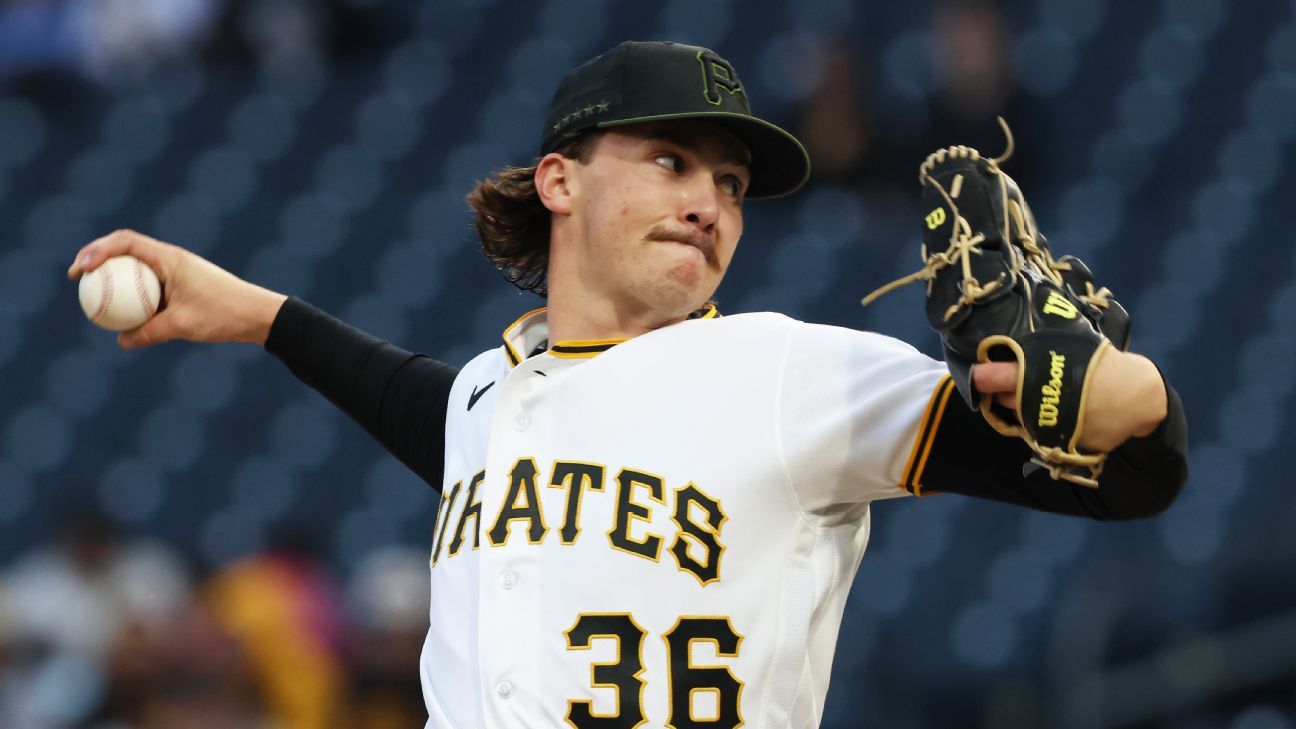
At the time, Chandler's fastball sat in the 88 to 89 mph vicinity, topping out at 91. He grew up in Georgia watching Jose Fernández, the incandescent Miami Marlins right-hander, and wanted to be like him. And Fernández, before he died at 24, occasionally reached triple digits, at that time a domain for only the most special arms. Between 2013 and 2016, when Fernández pitched in the major leagues, just 87 pitchers hit 100 mph.
Last year, that number spiked to 82, a single-season record in MLB. Chandler, a right-handed starter for the Pittsburgh Pirates, was one of them. This season, before the weather has warmed or most pitchers have been fully stretched out, 35 have topped 100.
With velocity training a staple of pitching programs, teams further prioritizing it in amateur talent acquisition and the average major league fastball edging toward 95 mph -- a full 6 mph harder than 25 years ago -- 100 remains a holy grail for pitchers. It has also become a milestone that's eminently within reach, suggesting that the velocity revolution that has taken over the game isn't slowing down soon.
"I feel like 100 is the new 95," said Los Angeles Dodgers reliever Will Klein, who first hit 100 in a summer ball all-star game in 2020 and expects to again this season, having topped out thus far at 98.8 mph. "It used to be, 'You throw 95, that's gas.' Now, it's 100. And now you see starters out there sitting 100. You have [New York Yankees right-hander Cam] Schlittler out there just sitting it -- he's throwing sinkers like 98 and you're like, 'What are we doing?' It's becoming more and more common."
The allure of 100 is mostly about the extra digit and humans' adoration of round numbers. Ask a hitter to tell the difference between 99 mph and 100 mph, and he can't. Nonetheless, it's a badge of honor for pitchers. Tall ones do it. (At 6-foot-8, Marlins right-hander Eury Perez has a 14 at 100-plus this year). Short ones do it. (The Cubs' 5-foot-11 closer, Daniel Palencia, has exceeded 100 seven times.) Starters and relievers do it, sometimes with the same frequency. (The MLB leaders this year: Milwaukee ace Jacob Misiorowski with 70 and unhittable San Diego closer Mason Miller with 60.)
A quarter century ago, a right-hander named Colt Griffin became the first high school pitcher to throw 100 -- and was drafted by Kansas City with the No. 9 pick even though he couldn't throw strikes. He retired four years later. Now, 100 is so common -- in the minor leagues, college, even high school -- that the best pitcher in the world worries it's being taken for granted.
"Throwing a baseball 100 miles an hour -- I don't think fans understand how hard that is to do," said Detroit ace Tarik Skubal, winner of two consecutive American League Cy Young Awards. "It looks easy on TV when big leaguers are doing it. It seems like everyone's got multiple guys that throw 100. But I do think it's not as easy as -- I know it's not as easy as what it looks like."
More than a century ago, Walter Johnson defined fastball velocity; he might have touched 100. In 1940, Bob Feller famously threw his fastball harder than a speeding police motorcycle, clocking in at 98.6 mph -- which, considering he was in street clothes and throwing on flat ground in Chicago, suggests he, too, hit 100. Even after Nolan Ryan threw 100 with regularity, there remained a mythic quality to the number, as if it were the domain only of those with arms kissed by fortune.
It turns out, 100 was lurking within all these years. The game just needed to find it.
"It seems like everyone throws 100," Dodgers manager Dave Roberts said. "And every hitter knows it."
Hitting 100 mph on the stadium scoreboard is a badge of honor for pitchers at any level. Jerome Miron-Imagn Images
IN HIS FIRST start at Double-A on June 21, 2005, Justin Verlander, who went on to throw hundreds of triple-digit pitches in the big leagues, came out consistently pumping 100 and 101 mph fastballs. After he struck out the first seven New Hampshire Fisher Cats hitters he faced, the radar gun in the stadium stopped working.
"I don't think they wanted to see their guys seeing 00 and 01 when they were walking up to the plate," said Don Kelly, now the Pirates' manager but who was an infielder behind Verlander that day.
Whether it was a malfunction or an active choice to shut it off, Kelly doesn't know. But it speaks to the power of 100 and its ability to infiltrate the psyche of a hitter.
"It's not the same just because it's not as rare," Kelly said. "I still don't know how these guys hit it. I think it's still difficult to hit when it's up to that speed."
Download the ESPN app and enable Jeff Passan's news alerts to receive push notifications for the latest updates first. Opt in by tapping the alerts bell in the top right corner. For more information, click here.
Which is why fastballs at 100-plus mph continue to flummox hitters. In plate appearances that have ended on such pitches this season, hitters are slashing .165/.248/.187. Last year wasn't much better: .193/.268/.283. Compare that with fastballs at 98 mph (.237/.326/.341), 95 mph (.267/.355/.432) and 90 mph (.281/.365/.479), and it's easy to understand why the industry is pursuing 100.
The most significant change came in the past half a decade, when a proliferation of pitching labs popped up around the country, equipped with technology that makes the humble radar gun look like a Commodore 64. Modeled after the labs that have become a necessity for major league teams across the game, all it took was a Trackman unit and an ultra-high-speed camera for trainers to optimize a player's velocity. The offseason is something of a misnomer because the majority of professional pitchers today spend their winter at work, often in search of another mile an hour or two to bring with them to spring training in February.
A pitcher showing up to camp, suddenly popping 100 mph, is not just within the realm of possibility; it's a golden ticket, as roster decisions often run parallel with a player's fastball velocity. With rare exception, throwing 100 eventually will guarantee a big league roster spot. It doesn't need to be for consistent strikes. It doesn't need to be particularly effective. Front offices hand immature -- but live -- arms to coaching staffs and task them with finding the consistency to help them stick.
The Colorado Rockies, forever in search of something that helps mitigate the thin air that has turned Coors Field into a hitting playground for three decades, have embraced velocity. Their bullpen owns the highest average fastball velocity in the major leagues this year at 96.6 mph. Between Chase Dollander and Victor Vodnik, they've got a pair of relief pitchers in the 100 mph club, and Juan Mejia, Jaden Hill and Antonio Senzatela -- all averaging over 97 mph on their fastballs -- could join them this season.
Developing 100 mph arms isn't nearly the chore it once was. Players happily forgot incremental velocity gains for leaps. After signing with the Oakland A's as a 20-year-old out of Venezuela, Palencia, who was throwing in the low 90s, used his signing bonus to improve his nutrition and workout equipment.
"By January, I was hitting 98," he said. "Then in spring, my first outing, I hit 100."
Teams also rely on a tried-and-true method that preceded the velocity revolution: the starter-to-reliever bump. Pirates left-hander Mason Montgomery spent three years as a starting pitcher at Texas Tech with a fastball in the 90 to 95 mph range. His fastball stayed there in the minor leagues with the Tampa Bay Rays, too, until they moved him into the bullpen in August 2024. In his first appearance, he hit 98, his hardest pitch of the season to that point, and a week later, he was sitting there.
Every ace wants to add something filthy to their arsenal. Sometimes it just doesn't work out.
Jeff Passan »
The freedom of pitching in relief -- knowing that for one inning, a pitcher can air it out with no need to ration his arm -- can unlock another level.
"I always thought I'm going max effort or relatively max effort," Montgomery said. "But I think maybe in the back of my mind I was also thinking, yeah, I got to go five, six, seven innings. So, that probably plays a part."