
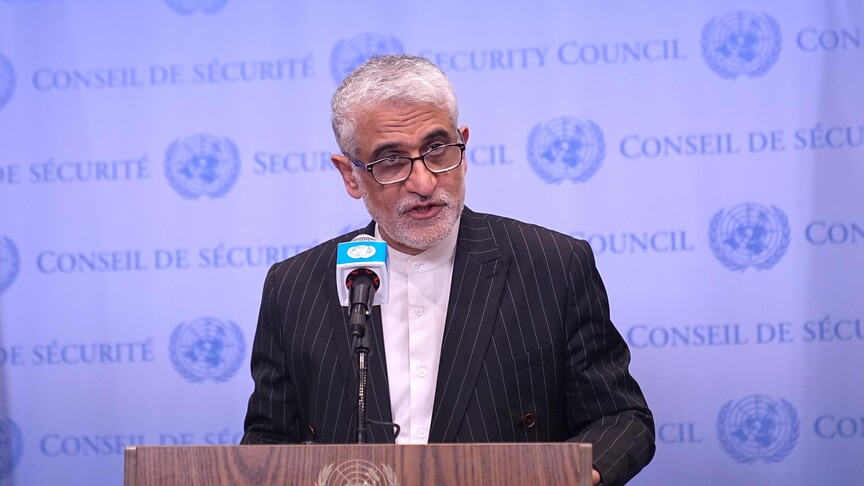
Iran's permanent representative to the UN on Thursday criticized a draft UN Security Council resolution sponsored by the US and Bahrain, accusing the two countries of attempting to legitimize what he called unlawful US actions in the Strait of Hormuz.
"The United States and the Kingdom of Bahrain have jointly tabled a deeply flawed, one-sided, and politically motivated draft resolution on the situation in and around the Strait of Hormuz.
"They claim that their actions are intended to protect freedom of navigation in the Strait of Hormuz and make some baseless allegations against my country. The fact on the ground proved otherwise," Ambassador Amir Saeid Iravani told the reporters.
Iravani argued that recent US actions in the Gulf contradict Washington’s stated objectives and have instead increased instability in the region.
"Instead, the US is pushing a flawed, politically motivated draft resolution on the pretext of freedom of navigation to advance its political agenda and legitimize unlawful actions, not to resolve the crisis," he said.
The US, alongside Bahrain, Saudi Arabia, the United Arab Emirates, Kuwait, and Qatar, drafted a UN Security Council Resolution to defend freedom of navigation in the Strait of Hormuz. The draft resolution requires Iran to cease attacks, mining, and tolling.
Iravani said the draft resolution does not seek to protect international navigation.
"The real purpose is to legitimize the unlawful action of the United States against Iran in the Persian Gulf and the Strait of Hormuz, including its illegal maritime blockade," he said, adding that the draft resolution also ignores the root cause of the current situation.
"If adopted, this resolution would seriously damage the credibility and impartiality of the Security Council," he warned.
Despite the escalating tensions, Iravani said Iran remains prepared to restore normal maritime traffic through the strategic waterway if hostilities cease and restrictions are removed.
"Let me stress clearly, Iran remains fully prepared to resolve normal maritime traffic and ensure freedom of navigation in the Strait of Hormuz, provided that the war is permanently ended and the unlawful blockade is lifted," he added.
Regional tensions have escalated since the US and Israel launched strikes against Iran on Feb. 28, triggering retaliation from Tehran against Israel as well as American allies in the Gulf, along with the closure of the Strait of Hormuz.
A ceasefire took effect on April 8 through Pakistani mediation, but talks in Islamabad failed to produce a lasting agreement. The truce was later extended by Trump without a set deadline.
The US has enforced a naval blockade targeting Iranian maritime traffic in the strait since April 13.
Trump announced Tuesday that the US military will temporarily pause "Project Freedom" to restore freedom of navigation for commercial shipping through the Strait of Hormuz, and said the American blockade will remain “in full force and effect.”