
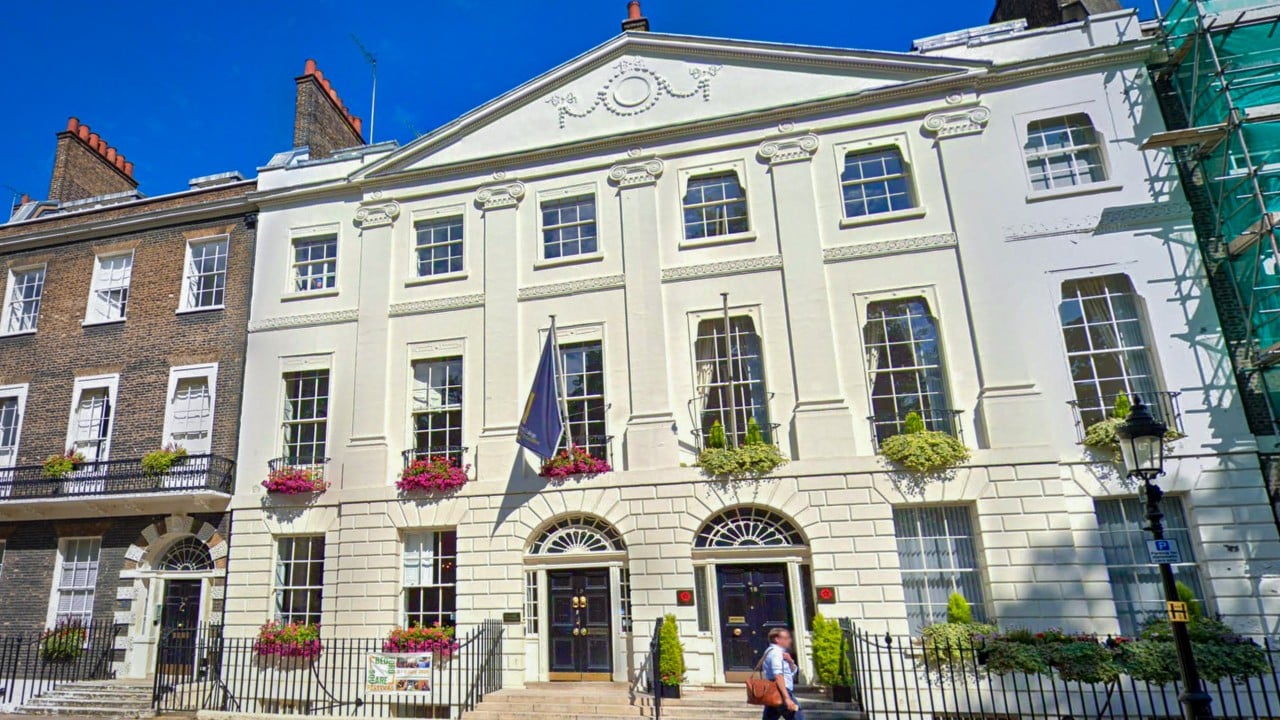
A British court has convicted two men linked to an Hong Kong Economic and Trade Office (HKETO) of spying on activists from the city on behalf of Chinese authorities.
Bill Yuen Chung-biu, the London office’s manager, and Peter Wai Chi-leung were found guilty of assisting a foreign intelligence service on Thursday, two years after their arrests thrust the role of Hong Kong’s overseas promotion offices into the global spotlight.
Yuen, a retired Hong Kong police superintendent, was earlier accused of passing on surveillance requests from city authorities while working at the HKETO to co-defendant Wai.
Prosecutors said Wai had used his position as a United Kingdom Border Force officer to gather personal information about Hong Kong activists in the UK using the Home Office’s computer systems.
The court heard that Nathan Law Kwun-chung, one of 19 wanted fugitives with HK$1 million (US$127,700) bounties placed on their heads by Hong Kong police, was among the targets.
The pair, both dual Chinese-British nationals, denied charges of assisting a foreign intelligence service by engaging in unlawful information gathering, illegal surveillance and committing acts of deception between December 2023 and May 2024, in violation of Britain’s National Security Act.
They also denied forcibly entering a residential property on May 1.
That same month, a third suspect, former Royal Marine and Border Force officer Matthew Trickett, was found dead 18 days after being released on bail.
During the trial, which started in early March, prosecutors said Yuen had received a list of British political figures – including Iain Duncan Smith, chairman of the Inter-Parliamentary Alliance on China – from a retired police officer, and was asked to gather details on their connections to certain activists and whether they were “causing disturbances in Hong Kong”.
Yuen told the court he reached out to Wai after the office was frequently targeted by protesters in 2021, saying help from the Parliamentary and Diplomatic Protection Command of London’s Metropolitan Police Service was only occasional and inadequate.
He said he considered Wai, who had a background as a volunteer police constable and had run a security company, to be the “perfect match” at the time, as he was looking for enhanced security services.
But Yuen denied that the contracts subsequently offered to Wai included carrying out surveillance for the HKETO.
Wai, during the trial, said that, after leaving the UK police in 2019, he was contacted by a retired Hong Kong officer who instructed him to follow Law and wanted former lawmaker Ted Hui Chi-fung for a monthly fee of HK$50,000.
He told the court that it was for a documentary about overseas Hongkongers.
A spokesman for the Hong Kong government on Thursday said that the allegations in the case were “absolutely unrelated” to the administration and the London trade office.
“Nor are we party to the case,” he said. “We firmly oppose any unfounded allegations against the [Hong Kong] government and the London [HKETO].”
He said the London trade office has been performing its duties in accordance with UK legislation, maintaining close contact with the government there and various parties to enhance the bilateral ties between Hong Kong and Britain.
It stated that given the “past assaults” on Hong Kong officials visiting Britain and “local disruptions” targeting the government, the London ETO had arranged for local security companies to provide the necessary security services and coordinate transport for senior officials’ visits.