
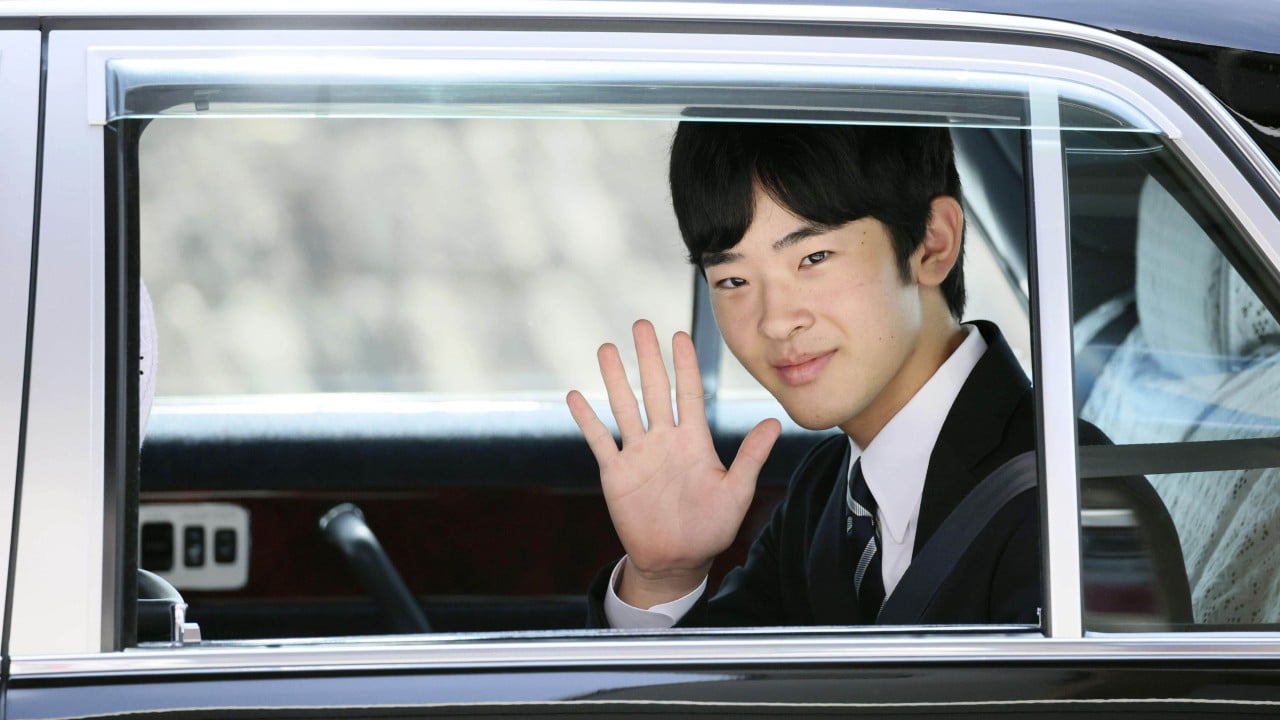
The young man on course to be Japan’s future emperor is attracting the attention of the country’s voracious media, with rumours of girlfriends and security challenges as a university student, and hints of unrest in the palace over succession.
Royalists say the media should leave 19-year-old Prince Hisahito alone to concentrate on his environmental studies course at the University of Tsukuba, while a debate mounts on whether the constitution should be altered to allow his cousin to become Japan’s first empress since the mid-1700s.
Despite a firm majority of ordinary Japanese supporting Princess Aiko’s claim to the throne as the firstborn of the reigning Emperor Naruhito, conservatives point out that the law does not permit an empress.
Repeated panels set up to consider the issue have failed to recommend amending the law to allow an empress and, more recently, Prime Minister Sanae Takaichi has indicated that she also favours retaining the presently accepted system.
Tabloid journalists counter that their coverage of the thorny issue is driven by readers’ interests, with Princess Aiko and the future of the monarchy a daily staple.
On Thursday, the Daily Shincho news magazine published a round-up of the latest tales circulating about Prince Hisahito. One is that he has a girlfriend; another suggests he may have to move because the location of his student accommodation was leaked, creating additional security challenges.
Another report suggests that his mother, Princess Kiko, wants her son to spend more time at the imperial palace in central Tokyo than at Tsukuba, about 60km to the north. According to the Daily Shincho story, the prince wants to maintain more distance and enjoy his university years before the duties of the emperor are thrust upon him.
All are fodder for the press, agrees Shiro Saito, a journalist with the Bunshun weekly news magazine who has covered numerous imperial family stories in the past.
“Readers – especially female readers – have always been fascinated by what is happening inside the imperial family,” he told This Week in Asia. “At the moment it’s Princess Aiko and the question of whether Japan might one day have an empress, but before her the attention was on her mother, Princess Masako.”
Now empress, Masako has had a torrid time since marrying then Crown Prince Naruhito in 1993. With the imperial family out of male heirs to the throne, she came under immediate pressure to have a son.
The speculation was so intrusive that it was not until 2001 that a child was born – and it was a girl who was not eligible to assume the throne. The pressure was so severe that Masako was diagnosed with an adjustment disorder in 2004 and was rarely seen in public for a decade.
With a male child unforthcoming, attention turned to Prince Akishino, the emperor’s younger brother, and his wife, Princess Kiko. The couple already had two older daughters but were able to swiftly avert a crisis by having a son, Hisahito, in September 2006.
Behind his father in line for the throne, he is the only other heir and while the traditionalists say he has solved the succession crisis, he will eventually come under huge pressure to also produce a son to continue the world’s longest-lived hereditary monarchy.
Hiromichi Moteki is one such traditionalist and says there is no longer even any need for more government panels to discuss the succession question.
“I don’t understand what they are thinking,” said Moteki, chairman of the deeply conservative Tokyo-based Society for the Dissemination of Historical Fact.
“Yes, there have been empresses in the past, but the last one was more than 250 years ago, the law on male succession is clear and we have a male heir. What is the problem?”
He is dismissive of the media coverage of the debate and says he does not read such reports.
“I don’t like to see this sort of speculative reporting and they should respect the prince’s privacy, as well as the privacy of the rest of the imperial family ... These stories only serve to confuse the situation surrounding the emperor question,” he said.
“I feel that if this [succession] law is changed now, that sets a precedent and it will be much easier to change other laws that affect the imperial family in the future.”
Saito agrees that some of the tabloid coverage may be a bit over the top, such as suggestions in some quarters of friction between Emperor Naruhito and Empress Masako – who want the law changed to allow their daughter to assume the throne – and Prince Akishino’s family, who firmly support adhering to protocol and having Prince Hisahito take over.
“It is clearly a complex family relationship but I do not think the empress would ever push her daughter to become empress,” he said, pointing to Masako’s stress-induced health problems.
“Maybe the emperor is more in favour of that course of action, but I do believe the entire imperial family is very aware of the need to do what is best for the nation.”