
China made Brazil its top global investment destination last year, pouring US$6.1 billion into the country across a record 52 projects. The figures come from the China-Brazil Business Council (CBBC), which released its annual report on Thursday.
The 45 per cent jump in value from the previous year far outpaced the 4.8 per cent rise in total foreign investment into Brazil. It also dwarfed China’s worldwide outbound flows, which grew just 1.3 per cent. Brazil absorbed 10.9 per cent of all Chinese overseas capital, ahead of the US at 6.8 per cent.
Tulio Cariello, the report’s author and director of research at CBBC, said the headline number mattered less than where Chinese money was going.
“We have seen greater diversification, including in areas where China used to invest in the United States,” he said.
Mining investment more than tripled, Chinese carmakers opened factories on sites vacated by Western carmakers, tech firms, including Meituan’s food delivery arm, launched operations and projects in sustainability and green energy hit a record 31, or 60 per cent of all Chinese ventures in Brazil that year.
Chinese firms poured US$1.76 billion into mining, more than triple the 2024 figure. CMOC bought gold mines from Canada’s Equinox Gold for roughly US$1 billion. MMG acquired Anglo American’s Brazilian nickel operations for US$500 million. And newcomer Baiyin Nonferrous bought a copper mine in the northeastern state of Alagoas for US$243 million.
The deals pushed mining to 29 per cent of all Chinese investment in Brazil, just 0.5 percentage points behind the electricity sector. Power retained its traditional lead at US$1.79 billion across 27 projects in solar, wind and hydroelectric generation.
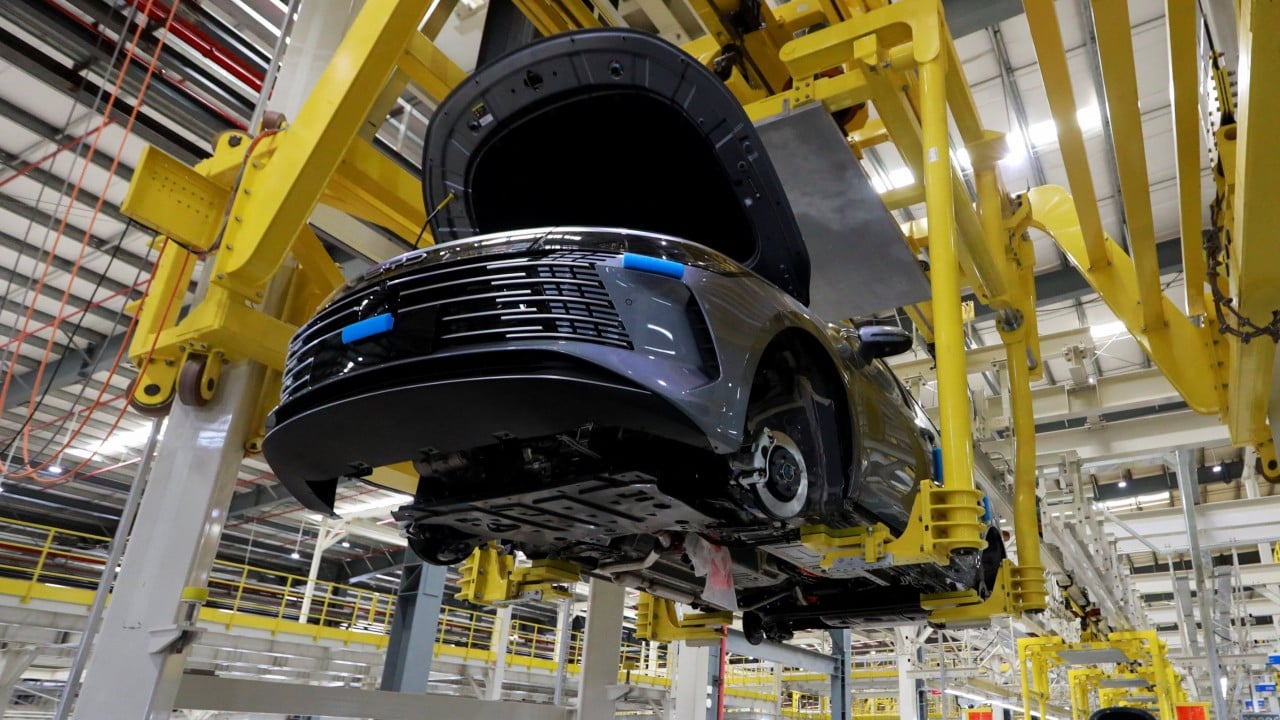
Chinese carmakers deepened their manufacturing presence in a country where they already dominate showrooms. BYD alone captured 72 per cent of electrified vehicle sales in 2025, and six of the top 10 brands were Chinese.
BYD and Great Wall Motor both inaugurated plants last year, taking over factory floors that Ford and Mercedes-Benz had abandoned. BYD’s facility in Bahia state produced roughly 20,000 vehicles between its October opening and year’s end. Geely acquired a 26.4 per cent stake in Renault’s Brazilian unit. The deal includes plans to build Geely models at a Renault factory in Parana state and invest in local research and development.
That expansion has drawn sharp resistance. Anfavea, the lobby group representing Volkswagen, Stellantis, General Motors and Toyota in Brazil, campaigned for months to end tariff concessions for Chinese firms. The concessions had let carmakers like BYD import vehicles as semi-assembled kits at reduced rates.
The group warned the practice could eliminate up to 69,000 direct jobs. It accused Chinese entrants of running assembly operations rather than building genuine manufacturing capacity. Executives from the four carmakers sent a joint letter to Lula urging him to block the relief.
The government sided with Anfavea in early 2026, restoring the standard 35 per cent duty on assembly kits. BYD responded by targeting 50 per cent local parts sourcing at its Bahia plant by the end of this year.
Cariello said the factories were too new to judge whether China was transferring real industrial capacity or replacing one form of dependency with another.
He noted that some firms were investing in research and development, including work on ethanol-compatible hybrid vehicles tailored for the Brazilian market. But he said deeper supply chain integration would not happen on its own.
“For that to actually happen, it really needs government support,” he said.
The carmakers were unlikely to leave, given their grip on the market, but the ambitious vision of integrated production chains had yet to materialise.
Between 2023 and 2025, manufacturing became the second-largest recipient of Chinese capital in Brazil, with US$2.66 billion, behind only the electricity sector. It surpassed both mining and oil, a shift from the historical pattern in which oil held second place.
Chinese technology firms also pushed into Brazil’s services sector, with estimated investments of US$379 million. Keeta, Meituan’s international brand, launched in Sao Paulo and Rio de Janeiro to compete with iFood, Brazil’s dominant food delivery platform. DiDi expanded its 99Food delivery service.
Cariello said the pattern echoed earlier waves of Chinese investment. State Grid and China Three Gorges entered Brazil’s electricity sector when their domestic market offered limited room for growth.
The same dynamic was now playing out in technology, he said. Firms facing saturation or regulatory constraints at home were turning to Brazil as the most attractive large market not closed to Chinese capital.
He added that Brazilian and Chinese consumers shared a strong orientation towards online commerce, making Brazil a natural fit.
The report landed as Brazilian President Luiz Inacio Lula da Silva arrived in Washington, where he is expected to meet US President Donald Trump. Rare earth minerals are on the agenda. So are tariffs, after Trump imposed a 50 per cent levy on Brazilian goods last July, which was later reduced.
The encounter captures the tug-of-war now playing out over Brazil’s resources. China controls more than 90 per cent of global rare earth refining. It dominates the processing of minerals used in electric vehicle batteries, wind turbines and military hardware. Brazil holds 26.5 per cent of the world’s graphite reserves and ranks as the second-largest holder of rare earths, behind only China.
Washington has responded with its own push. Last month, Nasdaq-listed USA Rare Earth agreed to acquire Serra Verde, the only large-scale rare earth producer outside Asia, for US$2.8 billion.
The deal was backed by US$565 million from the US Development Finance Corporation. Serra Verde’s mine sits in the central Brazilian state of Goias. It had sold its output to Chinese buyers before renegotiating those contracts to redirect production westward.
But even as the US moves to secure individual assets, the CBBC report shows Chinese capital spreading wider across Brazilian territory than ever.
Projects spanned 20 of Brazil’s 26 states in 2025, the widest geographic reach on record. Sao Paulo led with 17 projects, followed by Minas Gerais and Para with 10 each. The northern region, historically a marginal recipient, jumped to second place after China National Petroleum Corporation acquired nine exploration blocks in the Amazon River estuary.
That widening geographic reach reflects a deeper entrenchment across the Brazilian economy. Chinese firms have invested US$85.5 billion in the country across 355 projects since 2007. Brazil has ranked among the top five global destinations for Chinese capital every year since 2021.
A presidential election later this year could test that relationship. Polls show Lula facing a tight race with Flavio Bolsonaro, son of former president Jair Bolsonaro and less sympathetic to Beijing.
This scenario would not be without precedent in the region. China effectively froze investment in neighbouring Argentina after President Javier Milei took office in 2023, with a confrontational stance towards Beijing. But Cariello said Brazil’s institutional ties ran deeper than those of its neighbours and were not dependent on whoever occupied the presidential palace.
“I don’t see China pulling investment from here just because Brazil aligned on some specific point with the United States,” he said.
“I think our situation is quite different from the relationship Beijing had with Argentina; it’s more widespread and dynamic.”